






Web protocol adoption statistics - IPv6, HTTP/3 and TLS

Mendy Perlman, Researcher at Web Hosting Services By: Mendy Perlman | Updated: July 12, 2026 | Fact Checked |
Cite this Research

Cite this research

APA

Perlman, M. (2026, July 12). Web protocol adoption statistics - IPv6, HTTP/3 and TLS. Web Hosting Services. https://webhostingservices.co/research/web-protocol-adoption-statistics

MLA

Perlman, Mendy. “Web Protocol Adoption Statistics - IPv6, HTTP/3 and TLS.” Web Hosting Services, 12 July 2026, https://webhostingservices.co/research/web-protocol-adoption-statistics.

Chicago

Perlman, Mendy. “Web Protocol Adoption Statistics - IPv6, HTTP/3 and TLS.” Web Hosting Services. Last modified July 12, 2026. https://webhostingservices.co/research/web-protocol-adoption-statistics.
Research highlights: IPv6 just reached majority adoption, touching about 50% of Google’s traffic for the first time in 2026, after 18 years. In Cloudflare’s 2025 Year in Review, HTTP/2 handled about 50% of requests, while HTTP/3 remained near 21%, defying the “rapid takeover” story. TLS 1.3 now carries the clear majority of secure HTTP traffic in Cloudflare Radar’s protocol view, and Cloudflare reported post-quantum encryption reaching about 52% of TLS 1.3 request traffic in its 2025 Year in Review, nearly doubling from 29% at the start of the year. In the Internet Society’s April 2026 snapshot, country adoption ranged from about 73% in France to under 10% in some lower-adoption examples.

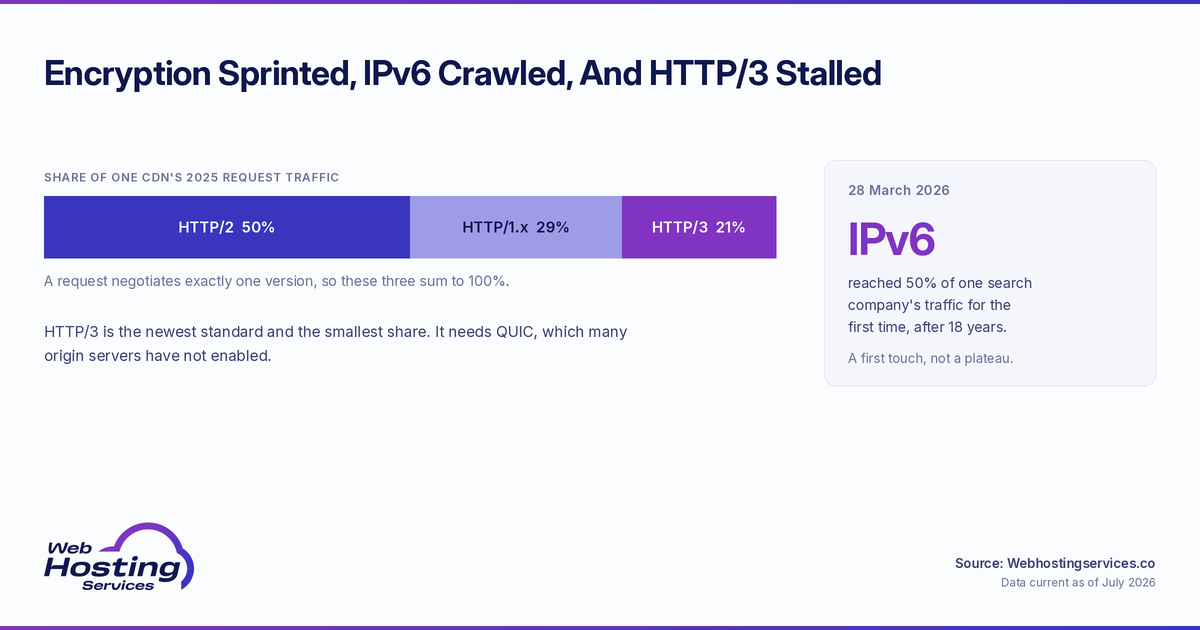
Featured infographic showing a stacked bar of 2025 request traffic with HTTP/2 at 50%, HTTP/1.x at 29% and HTTP/3 at 21%, beside a card noting IPv6 reached 50% of one search company's traffic on 28 March 2026.
HTTP/2 still handles half of all requests while HTTP/3, the newest standard, holds about a fifth.

What percentage of the internet supports IPv6?

Note: IPv6 adoption figures vary by measurement method, so different trackers report different shares.

  • Google shows about 45% to 50% of its traffic over IPv6, having just touched majority for the first time on March 28, 2026.
  • Cloudflare Radar also tracks IPv6 request share, but its figures vary by date range and by whether the metric is all requests, human traffic or IPv6-capable dual-stack traffic.
  • APNIC-style capability measurements put global IPv6 capability at roughly 42% to 43%, depending on date and weighting method.
  • The gaps reflect different measurement methods, not contradictions.
  • IPv6 offers 340 undecillion addresses, versus IPv4’s 4.3 billion.

Source

IPv6 share

Google (user traffic)

~45% to 50%

Cloudflare Radar (requests)

Varies by date range and methodology

APNIC / Pulse IPv6 capability

~42% to 43%

Reaching majority is a real milestone after a famously slow rollout. The varying figures all tell the same story: IPv6 is now mainstream, even if IPv4 stubbornly persists thanks to network address translation that stretched its limited supply for decades.


What is HTTP/2 and HTTP/3 adoption across websites?

Note: shares differ by method, since request-level measures (Cloudflare) and site-level ones (W3Techs) count differently.

  • In Cloudflare’s 2025 Year in Review, HTTP/2 handled about 50% of request traffic.
  • HTTP/1.x carried about 29%, and HTTP/3 about 21%.
  • HTTP/3 remains around one-fifth of Cloudflare request traffic in recent public readings, well behind HTTP/2.
  • By website support, W3Techs shows a higher HTTP/3 figure than Cloudflare’s request-level share, because it measures site-level usage rather than request negotiation.
  • HTTP/3 needs QUIC support, which many origin servers have not enabled.

Protocol

Request share

HTTP/2

~50%

HTTP/1.x

~29%

HTTP/3

~21%

The HTTP/3 plateau is the surprise. Despite being the newest standard, it remains far behind HTTP/2 in request-level usage, partly because HTTP/3 depends on QUIC support and real-world negotiation across browsers, CDNs and servers.


What share of traffic uses TLS 1.3?

  • TLS 1.3 now carries the clear majority of secure HTTP traffic in Cloudflare Radar’s protocol view.
  • It has overtaken TLS 1.2 in Cloudflare-observed secure HTTP traffic, though adoption varies by client, server and network.
  • TLS 1.3 offers faster handshakes and stronger security than its predecessor.
  • Cloudflare’s 2025 Year in Review reported post-quantum encrypted traffic rising from 29% to 52% during 2025, within its TLS 1.3 traffic view.
  • Older TLS versions are being actively phased out across the web.

Metric

Figure

TLS 1.3 share (Cloudflare Radar secure HTTP traffic)

Majority

Post-quantum encrypted traffic, Cloudflare 2025

~52%

Encryption is the one area moving fast. Unlike HTTP/3, TLS 1.3 and post-quantum key exchange have benefited from browser and major-network defaults, helping adoption move quickly across Cloudflare-observed traffic.


How fast is IPv6 adoption growing?

  • IPv6 took about 18 years to reach majority adoption since Google began tracking it in 2008.
  • Recent growth has been steady but uneven, with Google and APNIC-style measurements moving at different rates.
  • Growth is tied to ISP, mobile-network and content-provider deployment decisions, as well as pressure from IPv4 scarcity.
  • The Asia-Pacific region, served by APNIC, passed 50% adoption in 2025.
  • Adoption varies sharply by country and network, with both mature and fast-growing markets appearing among the leaders.

Metric

Figure

Years to reach majority

~18 years

Recent growth pattern

Steady but uneven by source, country and network

The pace has been famously patient. IPv6’s two-decade climb reflects how hard it is to upgrade core internet plumbing, but with IPv4 address space long exhausted and major ISPs, mobile networks and content providers deploying IPv6, the transition has finally reached a tipping point.


What is IPv6 adoption by country?

  • In the Internet Society’s April 2026 snapshot, France was around 73% IPv6 adoption.
  • India was close behind at about 72%.
  • Saudi Arabia was around 65%, with Malaysia near 60%.
  • The United States is above 50% in current Google-style country rankings.
  • In the same Internet Society snapshot, lower-adoption examples included Italy (17%), Spain (10%) and Egypt (4%).

Country

IPv6 adoption, Internet Society April 2026 snapshot

France

~73%

India

~72%

Saudi Arabia

~65%

United States

50%+ in current Google-style country rankings

The country gaps show that IPv6 adoption depends heavily on local network operators, mobile carriers, market structure and IPv4 scarcity. Some countries moved quickly, while others still rely heavily on IPv4. See our DNS statistics research.


Sources & additional resources

Web Hosting Services helps you evaluate modern hosting infrastructure, with independent protocol and hosting research, current hosting deals and managed WordPress hosting with free SSL, a built-in CDN, caching, tuned servers, managed updates, backups and security hardening.

Disclaimer: This article is for informational purposes only and is not legal, technical, cybersecurity, network-engineering, compliance, financial, business, hosting, infrastructure or purchasing advice. Web protocol adoption statistics, IPv6 traffic shares, HTTP/2 and HTTP/3 request data, TLS 1.3 usage, post-quantum encryption figures, country-level IPv6 adoption, APNIC capability measurements, Cloudflare Radar data, Google IPv6 statistics, W3Techs site-level protocol data and third-party methodologies can change at any time and may vary by source, reporting period, date range, geography, network, browser, CDN, traffic type, request classification, protocol negotiation, dual-stack configuration and measurement definition. Always confirm current figures, protocol support, hosting requirements, security requirements, compatibility needs, network assumptions and methodology directly with the cited source, hosting provider, CDN provider, browser documentation, network engineer, cybersecurity professional or qualified expert before making protocol, hosting, infrastructure, security, business or purchasing decisions based on web protocol adoption statistics.

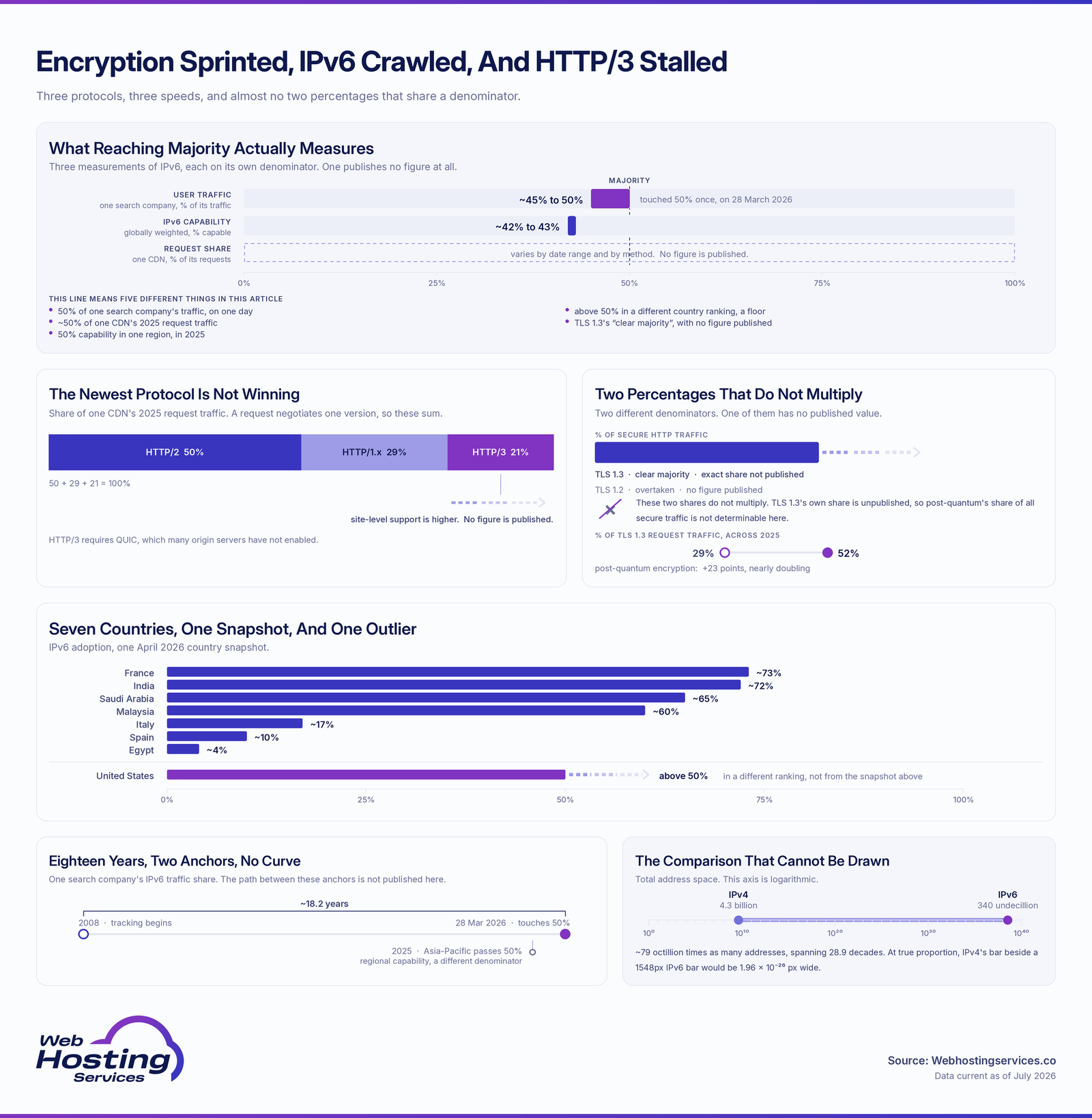
Web protocol adoption infographic showing IPv6 at 45% to 50% of one search company's traffic against 42% to 43% global capability, HTTP/2 at 50% of requests versus HTTP/3 at 21%, post-quantum encryption rising from 29% to 52% of TLS 1.3 traffic, and IPv6 adoption by country from 73% in France to 4% in Egypt.
The web's protocols are moving at three different speeds, and almost every percentage that describes them is a share of something different.