








 By: Mendy Perlman
|
Updated: June 21, 2026
|
Fact Checked
|
By: Mendy Perlman
|
Updated: June 21, 2026
|
Fact Checked
|
Cite this Research
Cite this research
Perlman, M. (2026, June 21). How much does cloud hosting cost? Web Hosting Services. https://webhostingservices.co/research/cloud-hosting-cost
Perlman, Mendy. “How Much Does Cloud Hosting Cost?” Web Hosting Services, 21 June 2026, https://webhostingservices.co/research/cloud-hosting-cost.
Perlman, Mendy. “How Much Does Cloud Hosting Cost?” Web Hosting Services. Last modified June 21, 2026. https://webhostingservices.co/research/cloud-hosting-cost.
How do cloud hosting pricing models work?
- Cloud hosting is usage-based, so you assemble a bill from compute, storage, and data transfer rather than paying one flat plan.
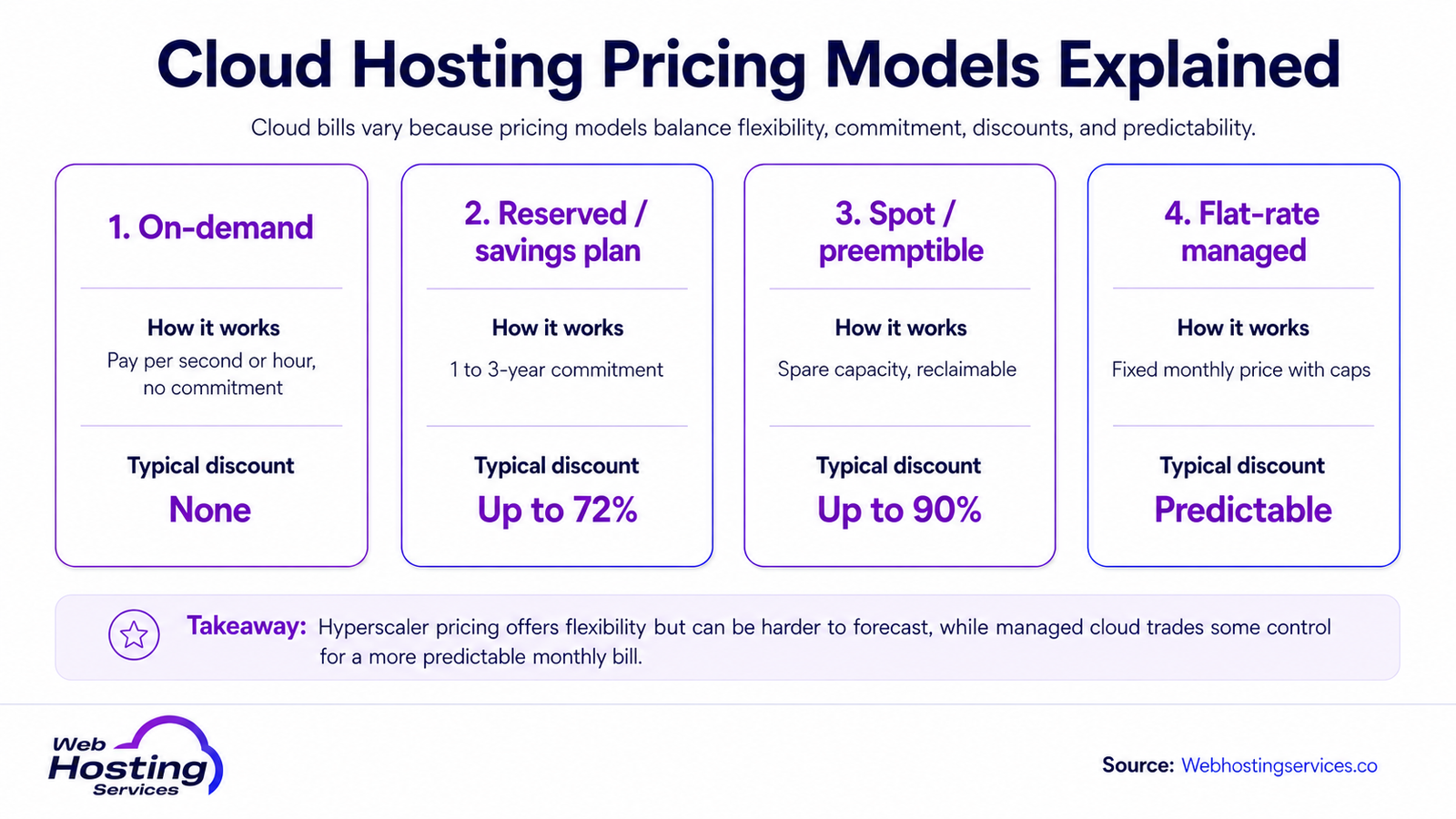
- On-demand pricing has no commitment and the highest rate, billed by the second or hour for compute.
- Reserved instances, reservations, and savings plans trade a 1 to 3-year commitment for lower compute rates, with AWS and Azure advertising savings up to 72% depending on plan, term, region, and workload.
- Spot or preemptible instances use spare capacity at deep discounts, but the provider can reclaim them.
- Managed cloud providers simplify this with flat monthly pricing and predictable caps.
Pricing model | How it works | Typical discount |
On-demand | Pay per second or hour, no commitment | None |
Reserved / savings plan | 1 to 3-year commitment | Up to 72% |
Spot / preemptible | Spare capacity, reclaimable | Up to 90% |
Flat-rate managed | Fixed monthly price with caps | Predictable |
The headline tension is flexibility versus predictability. Hyperscalers bill every component separately, which scales precisely but is hard to forecast. Managed cloud trades some control for a simple, capped monthly number.
How much does cloud hosting cost by provider (AWS, Azure, Google)?
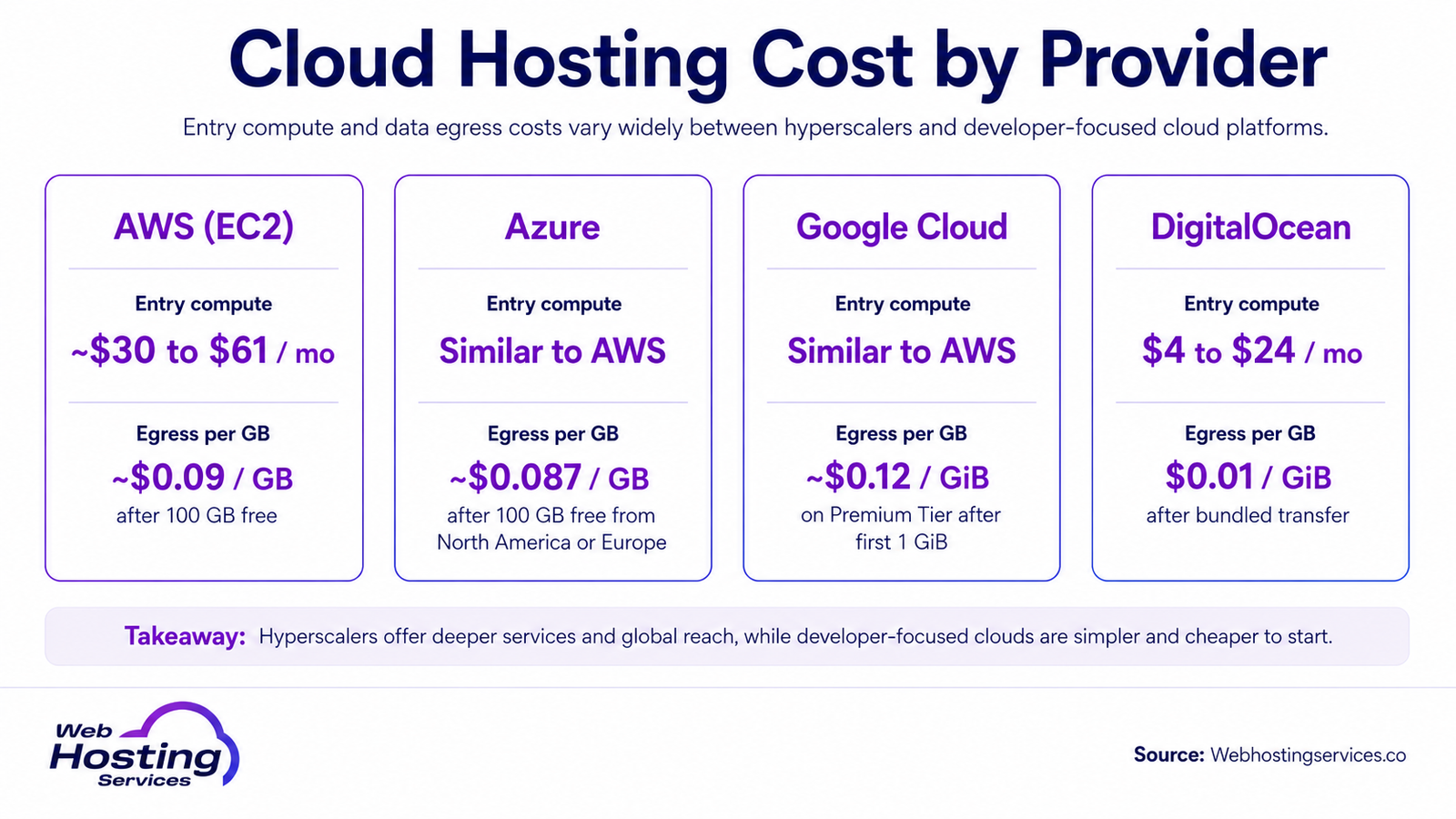
- On AWS, a general-purpose EC2 instance runs about $30 per month for a t3.medium and $61 per month for a t3.large, before storage.
- Azure and Google Cloud price compute similarly, with small differences by instance family and region.
- Egress separates them: examples include about $0.09 per GB on AWS after the 100 GB monthly free tier, $0.087 per GB on Azure from North America or Europe after the 100 GB monthly free tier, and $0.12 per GiB on Google Cloud Premium Tier for common destinations.
- Developer-focused cloud VMs are cheaper to start, with Vultr Cloud Compute from $2.50 per month and DigitalOcean Droplets from $4 per month.
- Hetzner also offers low-cost cloud servers with generous bundled transfer, but exact prices vary by region and instance family and should be checked directly on Hetzner before quoting a fixed monthly figure.
Provider | Entry compute | Egress per GB |
AWS (EC2) | ~$30 to $61 / mo | ~$0.09 / GB after 100 GB free |
Azure | Similar to AWS | ~$0.087 / GB after 100 GB free from North America or Europe |
Google Cloud | Similar to AWS | ~$0.12 / GiB on Premium Tier after first 1 GiB |
DigitalOcean | $4 to $24 / mo | $0.01 / GiB after bundled transfer |
The hyperscalers win on depth of services and global reach, but they cost more at the low end. For a single app or site, managed cloud delivers comparable compute for a fraction of the entry price and a far simpler bill.
How does cloud hosting cost compare to traditional hosting?
- Traditional shared hosting is a flat monthly fee, often $2 to $10 per month, with fixed resources.
- VPS hosting sits higher, around $10 to $100 per month, still on a predictable plan.
- Cloud hosting is usage-based, so it scales with traffic but produces a variable bill.
- For a small, steady site, shared hosting is cheaper and simpler than cloud.
- Cloud wins when traffic is spiky or growing fast, since you pay only for what you use and scale instantly.
Hosting type | Pricing | Typical monthly |
Shared hosting | Flat plan | $2 to $10 |
VPS hosting | Flat plan | $10 to $100 |
Managed cloud | Flat with caps | $2.50 to $84+ |
Hyperscaler cloud | Usage-based | $30 to hundreds |
Choose by traffic pattern, not by buzzword. Predictable, low-traffic sites usually cost less on shared or VPS hosting, while cloud earns its variable pricing when demand swings or scales quickly.
How much does cloud hosting cost for a small website?
- A small site runs comfortably on managed cloud, with DigitalOcean’s $6 per month tier handling most side projects.
- Vultr starts even lower at $2.50 per month, and the smallest plans include enough bundled bandwidth to avoid overage.
- The most popular small-app size is the $12 to $24 Droplet, with 2 to 4 GB of RAM and up to 4 TB of transfer.
- A real production setup with a managed database lands near $60 to $90 per month.
- Hyperscalers offer fixed-price plans too, but managed cloud is simpler for a single small site.
Small site setup | Typical monthly |
Entry managed cloud (512 MB to 1 GB) | $2.50 to $6 |
Small app (2 to 4 GB) | $12 to $24 |
Production app + managed database | $60 to $90 |
For a brochure site or low-traffic project, the entry tier is plenty, and bundled bandwidth means no surprise transfer bill. Start small, since managed cloud makes it easy to resize up once you know your real usage.
What hidden and egress costs come with cloud hosting?
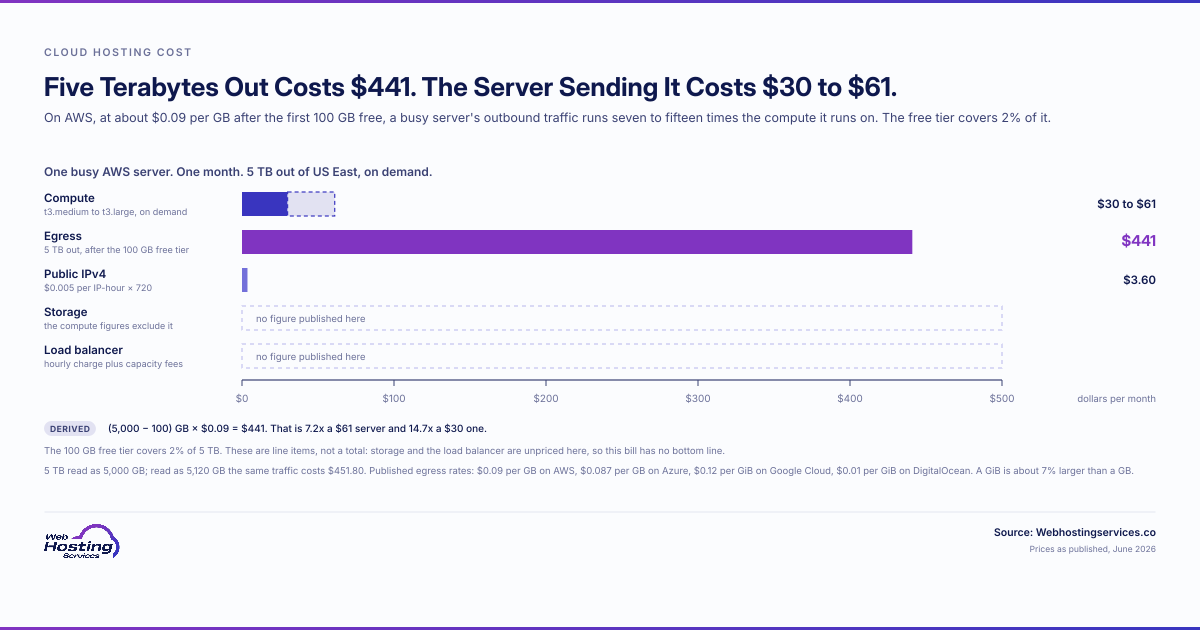
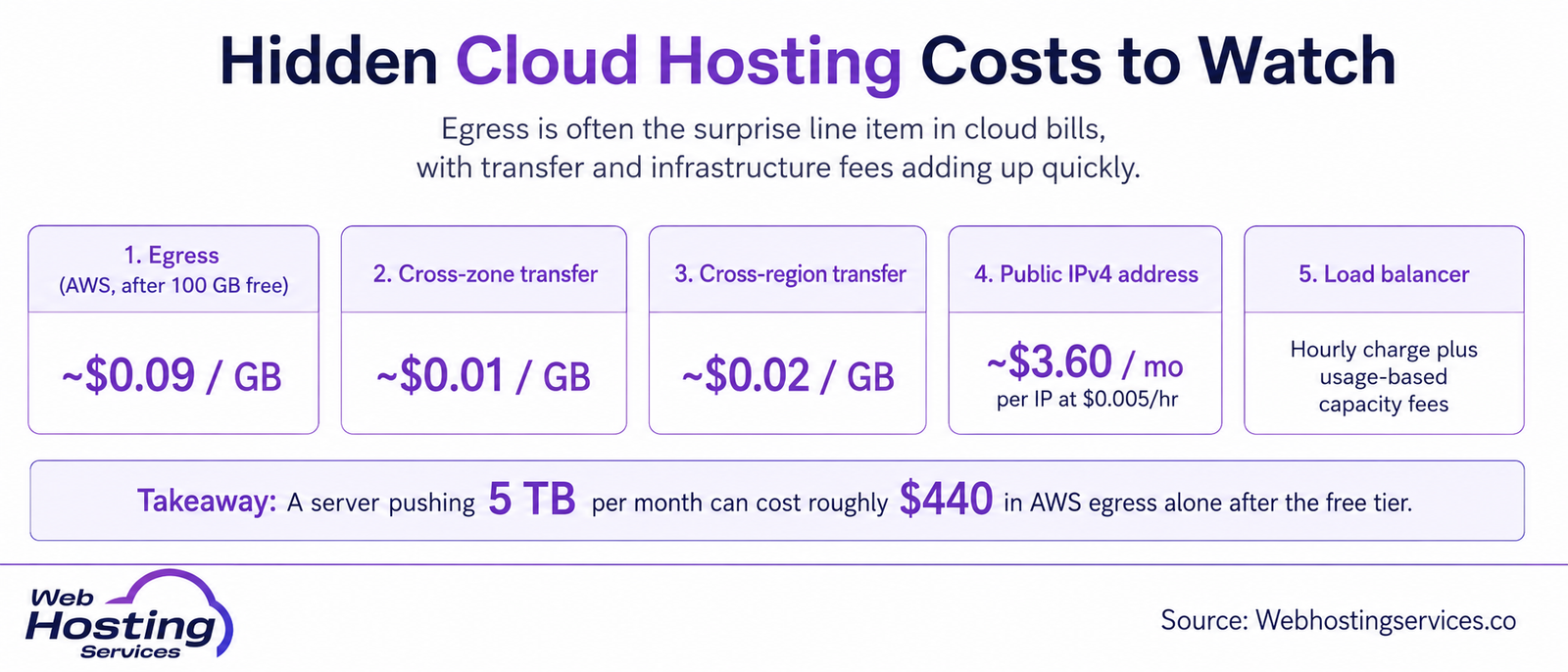
- Egress, the data transferred out to the internet, is the biggest surprise, at about $0.09 per GB on AWS after the first 100 GB free.
- A busy server pushing 5 TB a month can run roughly $440 in egress alone on AWS, at the $0.09 per GB rate after the free tier.
- Transfer between zones costs about $0.01 per GB, and between regions about $0.02 per GB.
- AWS public IPv4 addresses cost $0.005 per IP-hour, or about $3.60 per month at 720 hours, whether attached or idle; an AWS Application Load Balancer also adds an hourly charge plus usage-based LCU fees.
- Flat-rate developer cloud sidesteps much of this, since DigitalOcean bundles outbound transfer with Droplets and charges $0.01 per GiB for additional outbound transfer.
Hidden cost | Typical rate |
Egress (AWS, after 100 GB free) | ~$0.09 / GB |
Cross-zone transfer | ~$0.01 / GB |
Cross-region transfer | ~$0.02 / GB |
Public IPv4 address | ~$3.60 / mo per IP at $0.005/hr |
Load balancer | Hourly charge plus usage-based capacity fees |
Egress is where the cloud’s “pay for what you use” model bites. Model your data transfer before committing, use a CDN to cut origin egress, and remember that managed cloud and zero-egress storage options can dramatically lower the real bill.
Sources & additional resources
- “Amazon EC2 On-Demand Pricing.” AWS.
- “Bandwidth Pricing.” Microsoft Azure.
- “DigitalOcean Pricing.” DigitalOcean.
- “Cloud Data Transfer Pricing Comparison.” EgressCost.com.
- “Amazon EC2 Pricing Guide 2026.” Go-Cloud.
- “AWS Pricing Overview.” AWS.
- “Amazon EC2 T3 Instances.” AWS.
- “Compute and EC2 Instance Savings Plans.” AWS.
- “Amazon EC2 Spot Instances.” AWS.
- “New AWS Public IPv4 Address Charge.” AWS.
- “Elastic Load Balancing Pricing.” AWS.
- “Network Pricing.” Google Cloud.
- “Vultr Pricing.” Vultr.
- “Regular Performance Cloud Servers.” Hetzner.
- “Azure Reserved Virtual Machine Instances.” Microsoft Azure.
- “Droplet Pricing Details.” DigitalOcean Documentation.
Web Hosting Services helps you host for less, with independent cloud and hosting research, current hosting deals, and managed WordPress hosting for sites that want cloud-grade performance without the cloud-bill complexity.