







 By: Mendy Perlman
|
Updated: June 21, 2026
|
Fact Checked
|
By: Mendy Perlman
|
Updated: June 21, 2026
|
Fact Checked
|
Cite this Research
Cite this research
Perlman, M. (2026, June 21). How much does an SSL certificate cost? Web Hosting Services. https://webhostingservices.co/research/ssl-certificate-cost
Perlman, Mendy. “How Much Does an SSL Certificate Cost?” Web Hosting Services, 21 June 2026, https://webhostingservices.co/research/ssl-certificate-cost.
Perlman, Mendy. “How Much Does an SSL Certificate Cost?” Web Hosting Services. Last modified June 21, 2026. https://webhostingservices.co/research/ssl-certificate-cost.
Are free SSL certificates available, and how do they compare to paid?
- Free SSL is widely available, led by Let’s Encrypt, which has issued billions of certificates at no cost.
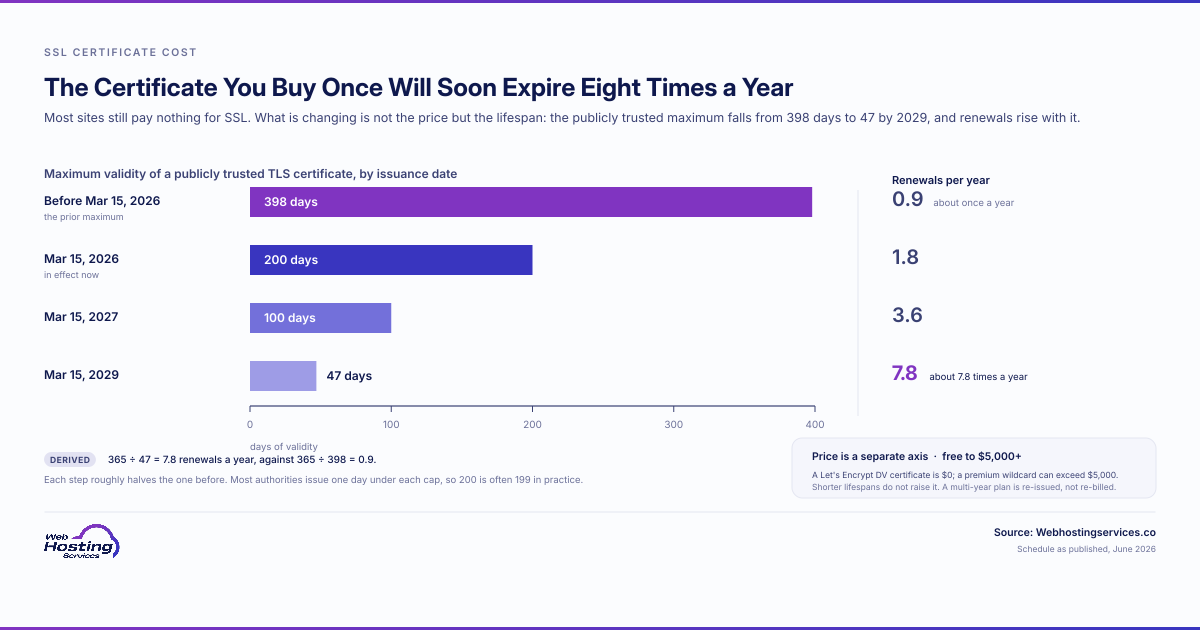
- Free certificates can use the same core HTTPS encryption strength as paid ones, so the cryptographic protection is comparable; paid certificates mainly add identity validation, warranties, support, seals and management features.
- Free certificates are domain validated (DV) only, with no business identity check, warranty or support.
- Most hosts bundle a free certificate automatically, so the typical website pays nothing for SSL.
- Paid certificates add business or extended validation, a warranty, a site seal and dedicated support.
Feature | Free SSL | Paid SSL |
Encryption strength | Same | Same |
Validation | Domain only | Domain, business or extended |
Warranty | None | $10,000 to $2 million |
Support | Community | Dedicated |
For a blog, portfolio or small business site, free SSL is usually enough. You pay for a certificate when you need verified business identity, a warranty, dedicated support, a site seal or certificate-management features beyond basic HTTPS encryption.
How much does an SSL certificate cost by type (DV, OV, EV, wildcard)?
- DV (domain validation) is cheapest, from free through Let’s Encrypt to under $10 per year from some resellers, while direct CA pricing can be higher.
- OV (organization validation) verifies your business and commonly costs from the low hundreds per year through major CAs, with premium brands costing more.
- EV (extended validation) adds the most rigorous organization vetting and usually costs more than DV or OV.
- Wildcard certificates secure unlimited subdomains at one domain level, with budget DV wildcard options under $100 per year from some resellers and premium OV wildcard subscriptions reaching several thousand dollars per year.
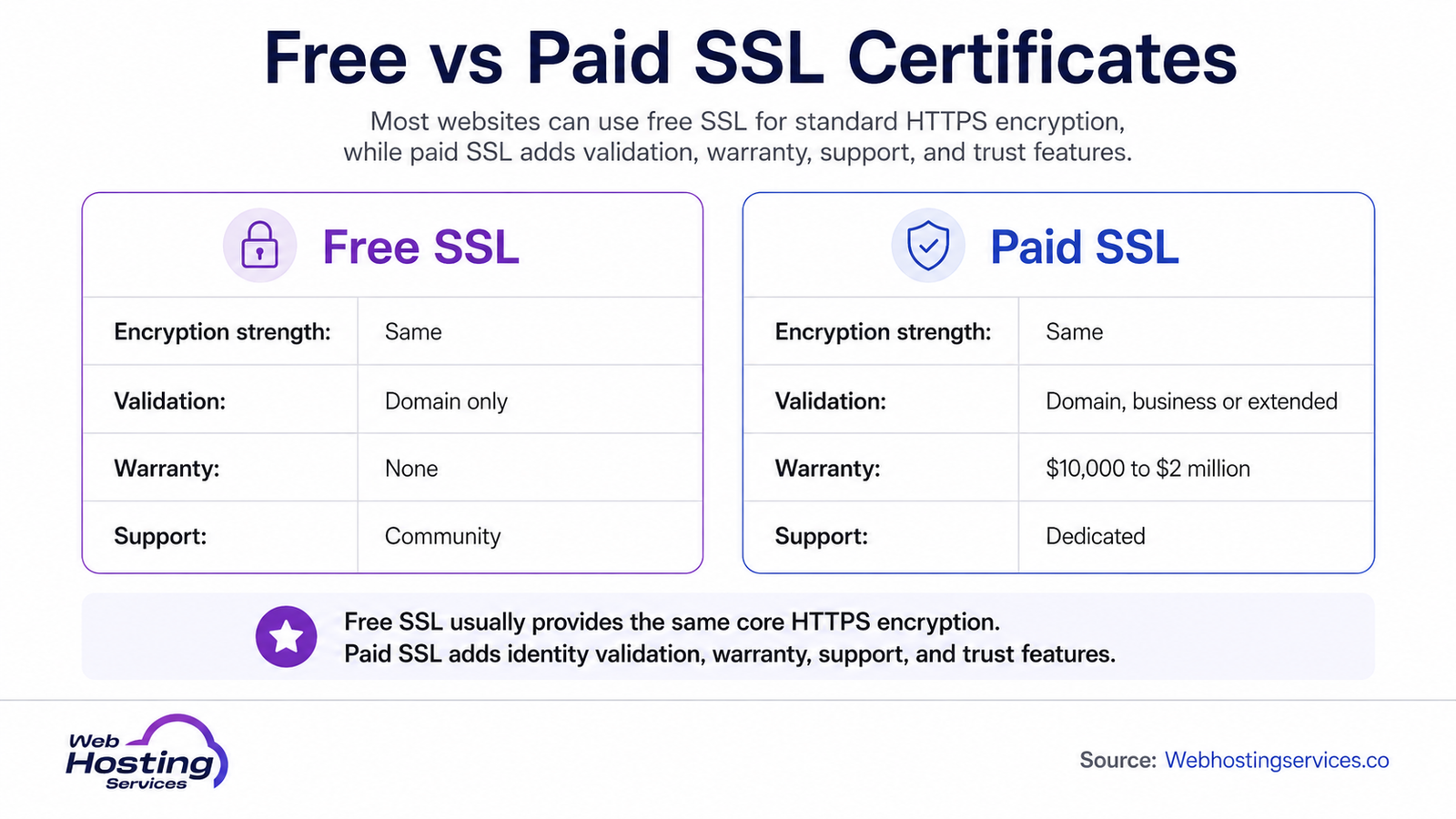
- Encryption can be comparable across certificate types; the price mainly reflects validation depth, warranty, support, brand, tooling and domain coverage.
Type | What it validates | Typical cost / yr |
DV | Domain ownership | Free to $110+ |
OV | Business identity | Low hundreds to $1,000+ |
EV | Extended company verification | Hundreds to $1,000+ |
Wildcard | Unlimited same-level subdomains | Under $100 to $5,000+ |
Choose by what you need to prove, not by price alone. A DV certificate secures any site, while OV and EV exist to display verified business identity, and wildcard pays off once you run several subdomains.
How much does SSL cost by certificate authority?
- Let’s Encrypt issues free DV certificates and is a free, automated, open certificate authority.
- Low-cost reseller listings for Sectigo/Comodo-branded DV certificates can start around $7.66 per year, while Sectigo’s own direct one-year single-domain DV pricing starts much higher.
- DigiCert is the premium authority, with official single-domain and wildcard subscriptions running from the hundreds to several thousand dollars per year depending on product tier and coverage.
- Thawte and GeoTrust are DigiCert-powered brands that usually sit below DigiCert’s flagship products but above the cheapest reseller DV certificates.
- Premium brands charge more for validation, warranty, support, lifecycle tooling, seals and brand assurance, not stronger basic encryption.
Authority / channel | Price range / yr | Position |
Let’s Encrypt | Free | Free DV, automated |
Sectigo / Comodo via resellers | ~$8+ for budget DV | Budget reseller pricing |
Sectigo direct | ~$110+ direct | Major CA, direct pricing |
DigiCert | Hundreds to $5,000+ | Premium, enterprise |
The huge price gap between Sectigo and DigiCert reflects brand, warranty and validation speed rather than security. Every publicly trusted certificate meets the same encryption standards, so match the authority to your trust and support needs.
How much does it cost to renew an SSL certificate?
- SSL renewal usually costs about the same as the initial purchase, unlike hosting with cheap intro rates and steep renewals.
- Buying a multi-year term lowers the average cost per year versus renewing annually.
- Free certificates renew at no cost; Let’s Encrypt certificates are currently valid for 90 days, and renewal is typically automated through the host or ACME client.
- As validity periods shrink, renewals happen more often, which pushes everyone toward automated renewal.
- An expired certificate triggers browser security warnings, so timely renewal matters more than the price.
Certificate | Initial | Renewal pattern |
Free (Let’s Encrypt) | $0 | Currently 90-day certificates, usually renewed by automation |
Paid DV / OV / EV | Per term | Roughly the same on renewal |
Multi-year bundle | Higher upfront | Lower cost per year |
Because SSL is priced per term with little renewal markup, the smarter saving is automation, not hunting for a discount. Automated renewal removes the risk of an expired certificate taking your site offline.
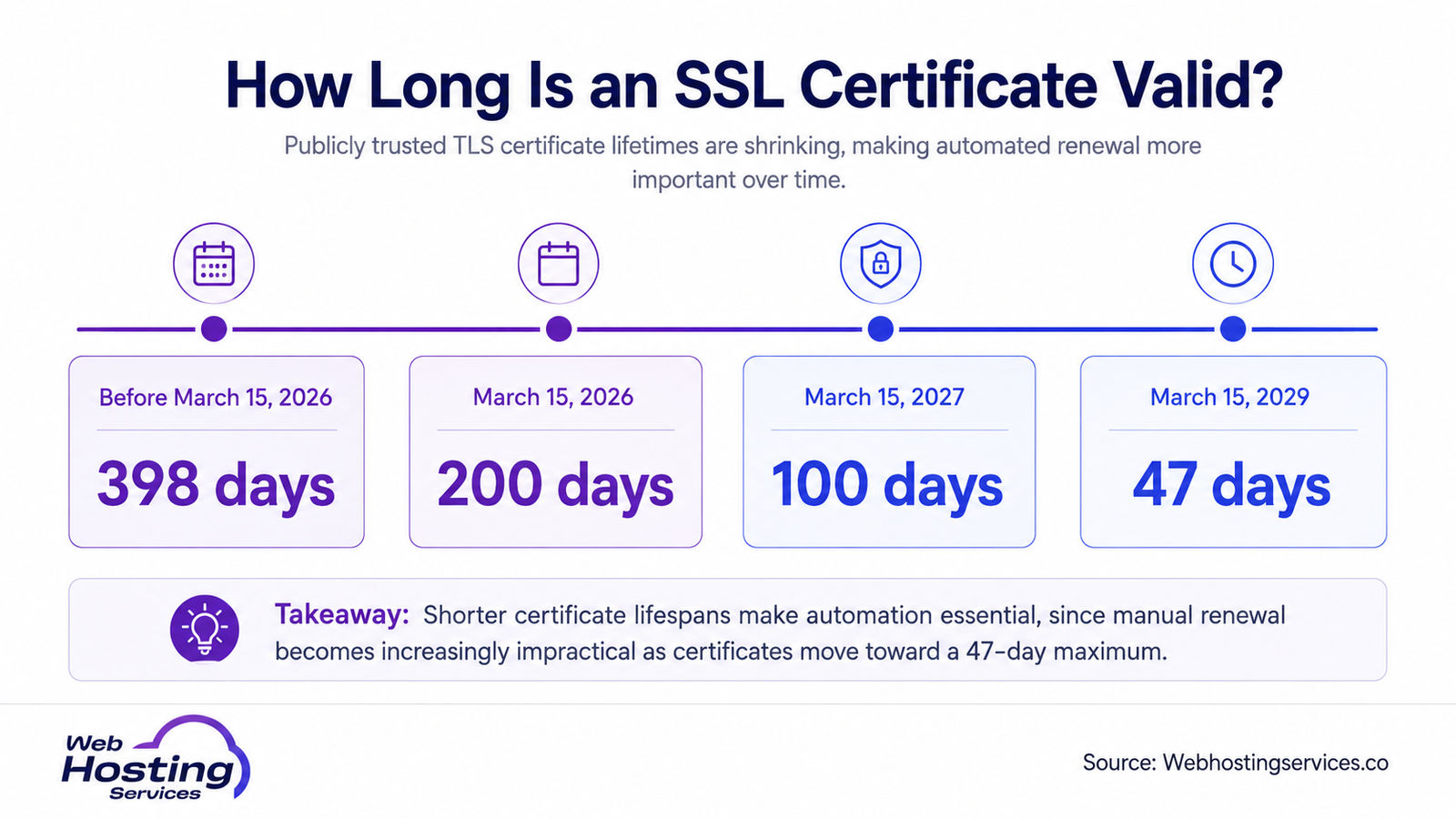
How long is an SSL certificate valid (and how is that changing)?
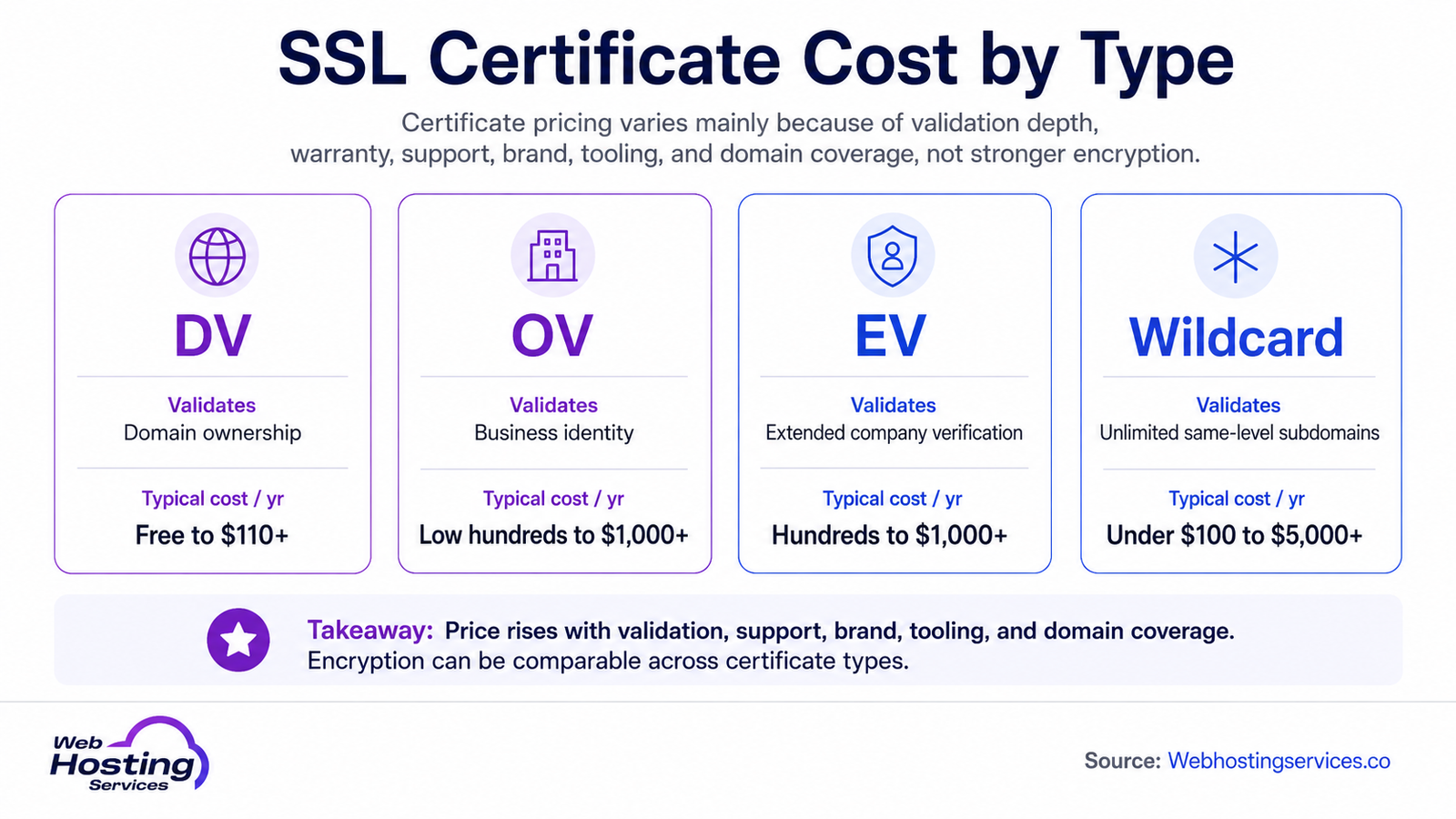
- Publicly trusted TLS server certificates used to have a maximum validity of about 398 days.
- For newly issued publicly trusted TLS certificates, maximum validity dropped to 200 days on March 15, 2026.
- It falls to 100 days on March 15, 2027.
- It drops again to just 47 days on March 15, 2029.
- The goal is stronger security and fresher validation data, since shorter lifespans limit the damage from stale or compromised certificates.
Effective date | Maximum validity |
Before March 15, 2026 | 398 days |
March 15, 2026 | 200 days |
March 15, 2027 | 100 days |
March 15, 2029 | 47 days |
Shorter lifespans make manual renewal impractical, so automated tools like ACME become the default whether the certificate is free or paid. The trend favors automated certificate lifecycle management over manual renewals and long-lived certificates. For the wider shift to secure browsing, see our web protocol adoption research.
Sources & additional resources
- “Free, Automated, and Open Certificate Authority.” Let’s Encrypt.
- “Compare TLS/SSL Certificates.” DigiCert.
- “Compare SSL Certificate Options.” Sectigo.
- “Ballot SC-081v3: Schedule of Reducing Certificate Validity.” CA/Browser Forum.
- “How Much Does an SSL Certificate Cost in 2026.” SSL Dragon.
- “Decreasing Certificate Lifetimes to 45 Days.” Let’s Encrypt.
- “Compare Wildcard TLS/SSL Certificates.” DigiCert.
- “TLS Certificate Lifetimes Will Officially Reduce to 47 Days.” DigiCert.
- “GeoTrust SSL Certificates.” GeoTrust.
Web Hosting Services helps you secure your site for less, with independent hosting and security research, current hosting deals that bundle free SSL, and managed WordPress hosting with SSL and automatic renewal built in.