








Domain registration lifecycle - terms, renewals and limits
 By: Mendy Perlman
|
Updated: July 10, 2026
|
✓Fact Checked
|
By: Mendy Perlman
|
Updated: July 10, 2026
|
✓Fact Checked
|
Cite this Research
Cite this research
Perlman, M. (2026, July 10). Domain registration lifecycle - terms, renewals and limits. Web Hosting Services. https://webhostingservices.co/research/domain-registration-rules
Perlman, Mendy. “Domain Registration Lifecycle - Terms, Renewals and Limits.” Web Hosting Services, 10 July 2026, https://webhostingservices.co/research/domain-registration-rules.
Perlman, Mendy. “Domain Registration Lifecycle - Terms, Renewals and Limits.” Web Hosting Services. Last modified July 10, 2026. https://webhostingservices.co/research/domain-registration-rules.
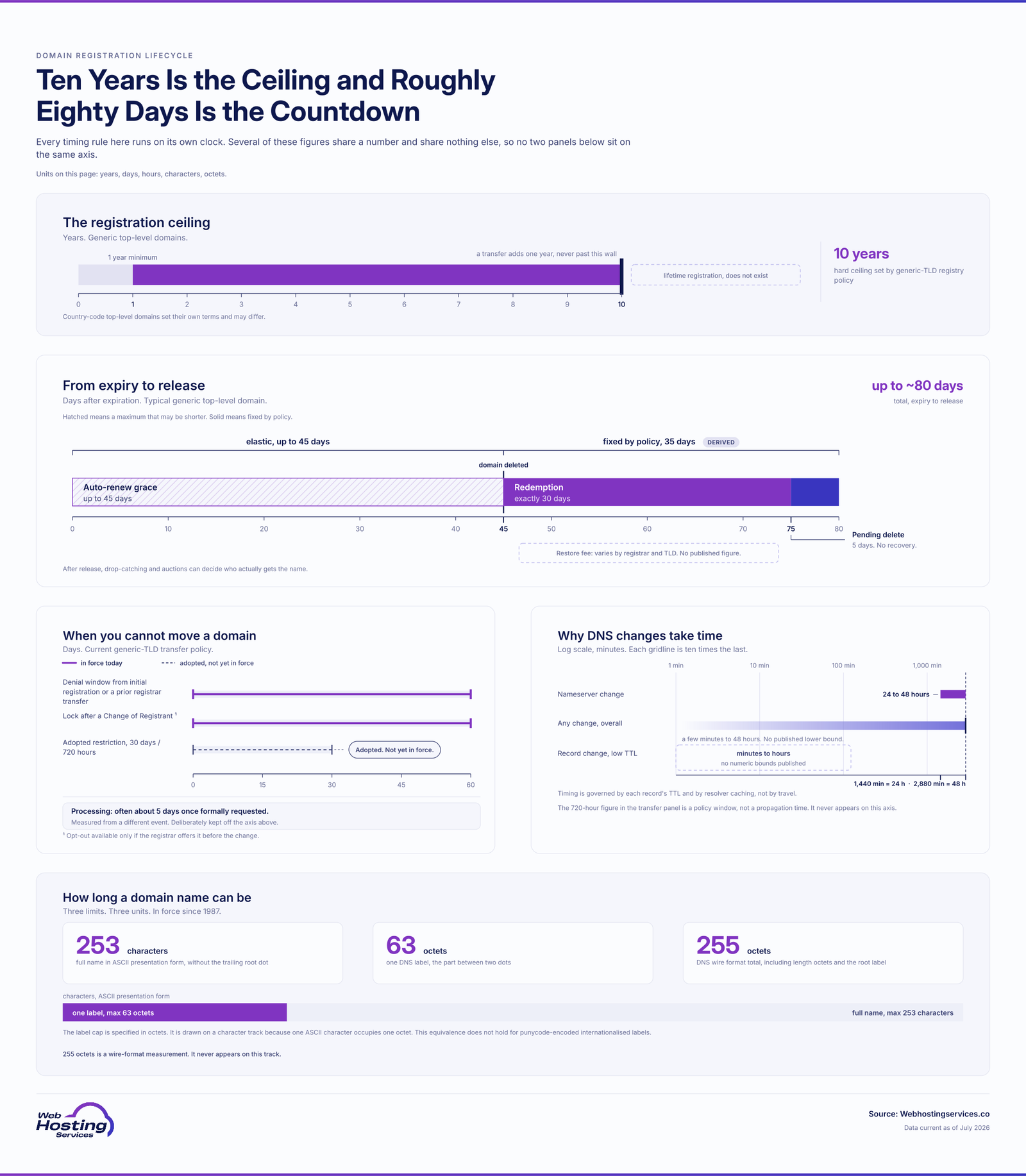
Research highlights: You can register a domain for 1 to 10 years, with 10 the hard maximum set by ICANN’s Base Registry Agreement. After post-expiration deletion, most gTLDs enter a 30-day Redemption Grace Period that lets the registrar restore the name for a fee. Current ICANN transfer materials still describe 60-day transfer restrictions or locks in several situations, while ICANN’s Board has adopted Transfer Policy Review recommendations that would replace some 60-day restrictions with a 30-day / 720-hour version once implemented. A domain name can run up to 253 characters in ordinary ASCII presentation form, based on RFC 1035’s 255-octet DNS wire-format limit. From expiry to release takes up to about 80 days.
How many years can you register a domain name for?
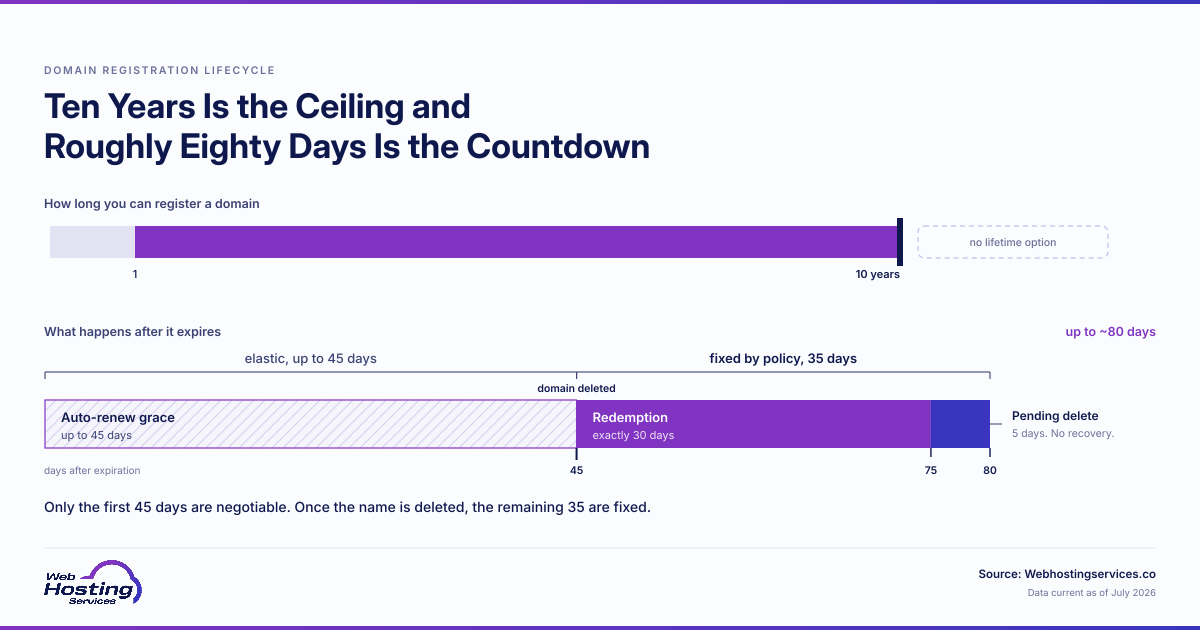
- You can register a domain for any term from 1 to 10 years.
- Ten years is the hard maximum set by ICANN’s Base Registry Agreement.
- You can renew at any time to extend the total back toward 10 years.
- There is no “lifetime” or permanent registration for any gTLD.
- Country-code TLDs set their own rules and may differ.
|
Metric |
Limit |
|
Minimum term |
1 year |
|
Maximum term |
10 years |
|
Lifetime registration |
Not available |
The 10-year cap is universal across generic domains, so any service promising to lock in a name “forever” is really just managing renewals for you. To keep a domain long-term, you simply renew before each term ends.
How long is the domain redemption and grace period?
- An auto-renew grace period of up to 45 days can follow expiration for many gTLDs.
- Registrar recovery windows, renewal options and post-expiration fees vary, so registrants should check their registrar’s published expiration policy.
- After deletion, most gTLDs enter a 30-day Redemption Grace Period.
- During redemption, the domain can generally be restored only through the registrar that deleted it.
- Restoring a domain in redemption usually involves a separate restore or redemption fee, but the amount varies by registrar and TLD.
|
Stage |
Duration |
|
Auto-renew grace period |
Up to 45 days |
|
Redemption grace period |
Exactly 30 days |
|
Restore fee |
Varies by registrar and TLD |
The redemption period is your last real chance to recover a lapsed name, but it comes at a premium. During redemption the domain cannot be transferred, only restored by your existing registrar, which is why acting quickly matters.
How long does DNS propagation take?
Note: propagation time depends on TTL settings and resolver caching, so it varies widely.
- Changes typically take anywhere from a few minutes to 48 hours.
- The timing is governed by each record’s TTL (time to live).
- Nameserver changes can take longer than simple record edits and are often described by registrars as taking up to 24 to 48 hours.
- Record edits propagate faster when the TTL is low.
- It is really cached records expiring across resolvers, not literal travel.
|
Change type |
Typical time |
|
Record change (low TTL) |
Minutes to hours |
|
Nameserver change |
24 to 48 hours |
The word “propagation” is misleading, since DNS changes are mostly about cached answers expiring. Lowering TTL before a planned record change can make that record update visible faster, although nameserver and registry-level changes can still depend on resolver, registrar and registry behavior.
How long does a domain transfer take?
- Current ICANN materials say a registrar may deny transfer requests within 60 days of initial registration or a previous registrar transfer.
- Current ICANN materials also describe a 60-day inter-registrar transfer lock after a Change of Registrant, with an opt-out option only if the registrar offers it before the change.
- ICANN’s Board has adopted Transfer Policy Review recommendations that would replace some 60-day transfer restrictions with a 30-day / 720-hour restriction once implemented.
- Once formally requested, a registrar transfer often completes within about 5 days unless it is explicitly approved, denied or otherwise delayed.
- It requires an authorization / EPP / transfer code and registrant approval, and normally adds one year to the expiration date, as long as the total remaining term does not exceed 10 years.
|
Metric |
Figure |
|
Transfer lock (current) |
60 days |
|
Transfer lock recommendation |
30 days / 720 hours, adopted by ICANN Board and pending implementation |
|
Transfer processing |
Often about 5 days once formally requested |
Transfer restrictions are designed to reduce unauthorized transfers and domain hijacking risk. Under current ICANN guidance, some 60-day situations are mandatory and others are registrar-discretionary, while the ICANN Board-adopted 2026 recommendations still need to be framed as pending implementation until the updated policy takes effect.
What is the maximum length of a domain name?
- A full domain name in ordinary ASCII presentation form can be at most 253 characters without the trailing root dot.
- Each DNS label, the part between dots, is capped at 63 octets.
- The underlying RFC 1035 limit is 255 octets in DNS wire format, including label-length octets and the terminating root label.
- These limits come from RFC 1035, published in 1987.
- The rules have stayed unchanged for nearly four decades.
|
Component |
Maximum length |
|
Full domain name, ASCII presentation form |
253 characters without the trailing root dot |
|
Single DNS label |
63 octets |
|
Wire format total |
255 octets |
These limits are generous in practice, since almost no usable name approaches 253 characters. The per-label cap of 63 is the one people actually hit, which is why no single segment of a domain can run longer than that.
How long after a domain expires does it become available?
- An auto-renew grace period of up to 45 days comes first.
- Then a 30-day redemption period allows restoration for a fee.
- Next is pending delete, a final 5-day stage with no recovery.
- For a typical gTLD that uses the full 45-day auto-renew grace period, the whole process can run up to about 80 days from expiration.
- After final deletion, the name is released for registration, but drop-catching, auctions and registrar-specific practices can affect who actually gets it.
|
Stage |
Duration |
|
Auto-renew grace |
Up to 45 days |
|
Redemption |
30 days |
|
Pending delete |
5 days |
|
Total to release |
Up to ~80 days |
An expired domain does not become available overnight. The roughly 80-day buffer protects owners from accidental loss, but it also means anyone waiting to grab a dropped name faces a long, uncertain queue. For pricing, see our domain name cost research.
Sources & additional resources
- ICANN. “Domain Name Renewal and Expiration FAQs.” ICANN.
- ICANN. “Renewing Domain Names.” ICANN.
- ICANN. “About Redeeming a Domain Name in Redemption Grace Period.” ICANN.
- ICANN. “Expired Registration Recovery Policy.” ICANN.
- ICANN. “5 Things Every Domain Name Registrant Should Know About ICANN’s Transfer Policy.” ICANN.
- ICANN. “Transfer Policy.” ICANN.
- ICANN. “Base Registry Agreement.” ICANN New gTLD Program.
- GNSO. “PDP Transfer Policy Review.” ICANN GNSO.
- ICANN. “Approved Resolutions: Regular Meeting of the ICANN Board, 7 June 2026.” ICANN.
- Domain Incite. “ICANN to Kill Off 60-Day Domain Transfer Lock.” Domain Incite.
- IETF. “RFC 1035: Domain Names Implementation and Specification.” RFC Editor.
- Cloudflare. “Time to Live (TTL).” Cloudflare DNS Docs.
- GoDaddy. “What Factors Affect DNS Propagation Time?.” GoDaddy Help.
Web Hosting Services helps you manage domains the smart way, with domain and hosting research, domain and hosting deals and managed WordPress hosting for site owners who want help managing hosting, maintenance and reliability.
Disclaimer: This article is for informational purposes only and is not legal, technical, domain-management, business, financial, tax, trademark, hosting or purchasing advice. Domain registration terms, renewal windows, redemption periods, transfer restrictions, DNS propagation timing, domain length rules, expiration timelines, ICANN policies, registrar procedures, registry requirements, restore fees and pending policy changes can change at any time and may vary by TLD, registrar, registry, country-code authority, contract terms and implementation date. Always confirm current rules, deadlines, fees, transfer eligibility, renewal requirements, domain ownership details, DNS settings and policy status directly with your registrar, registry, ICANN materials, official technical standards, legal advisor or qualified professional before making domain registration, renewal, transfer, recovery, hosting or purchasing decisions based on domain registration lifecycle information.