




Website accessibility statistics

Mendy Perlman, Researcher at Web Hosting Services By: Mendy Perlman | Updated: July 8, 2026 | Fact Checked |
Cite this Research

Cite this research

APA

Perlman, M. (2026, July 8). Website accessibility statistics. Web Hosting Services. https://webhostingservices.co/research/website-accessibility-statistics

MLA

Perlman, Mendy. “Website Accessibility Statistics.” Web Hosting Services, 8 July 2026, https://webhostingservices.co/research/website-accessibility-statistics.

Chicago

Perlman, Mendy. “Website Accessibility Statistics.” Web Hosting Services. Last modified July 8, 2026. https://webhostingservices.co/research/website-accessibility-statistics.
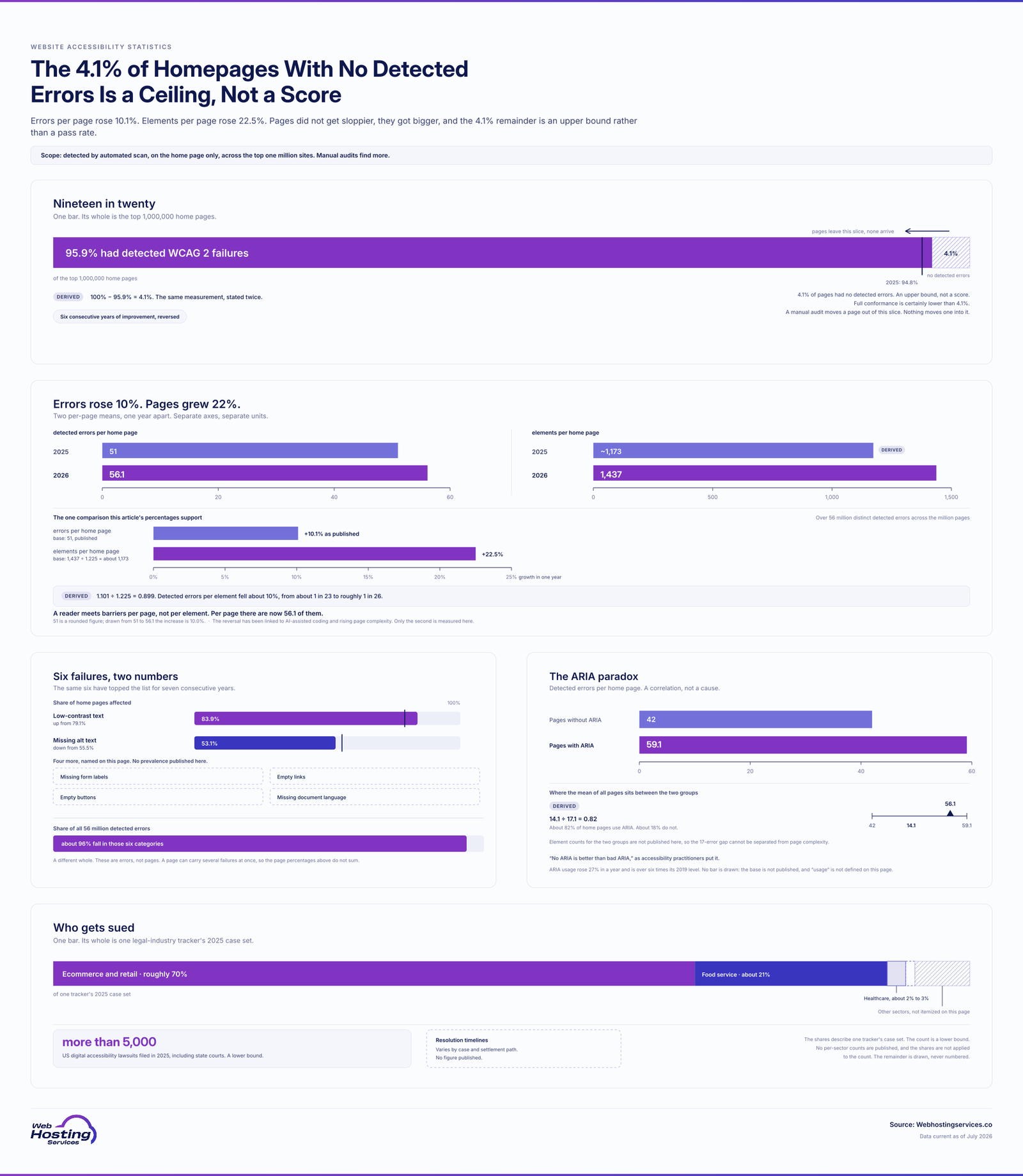
Research highlights: A striking 95.9% of the top one million homepages have detectable accessibility failures. Pages average 56.1 errors each, up 10.1% in a year, reversing six years of slow progress. Just six issue types cause about 96% of all failures, and low-contrast text alone affects 83.9% of pages. Meanwhile, thousands of accessibility lawsuits are filed each year.

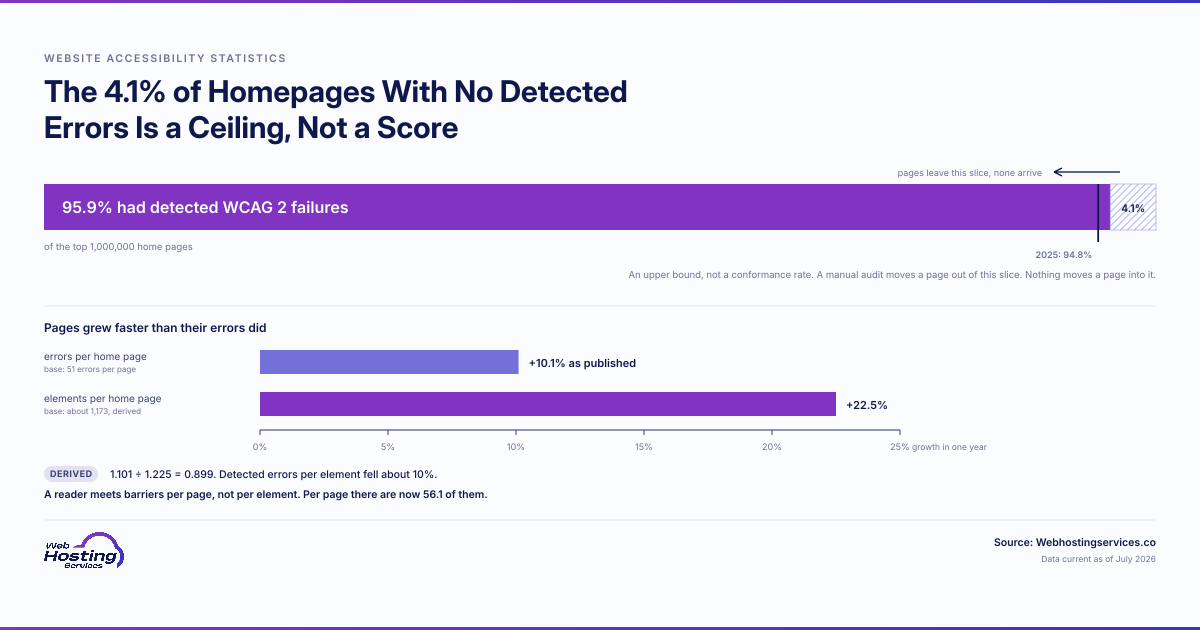
Featured image showing one bar of the top million home pages with 95.9% carrying detected WCAG 2 failures and a hatched 4.1% remainder labelled an upper bound, above a growth comparison in which errors per page rose 10.1% while elements per page rose 22.5%, so detected errors per element fell about 10%.
Pages did not get sloppier. They got bigger, and only 4.1% of them had nothing an automated scan could find.

What percentage of websites have accessibility errors?

  • 95.9% of the top one million homepages have detectable WCAG failures.
  • That figure rose from 94.8% the year before, a step backward.
  • Full WCAG 2 A/AA conformance was certainly lower than 4.1% of pages.
  • The 2026 result reversed six years of gradual improvement.
  • Automated scans catch only a fraction of what manual audits would find.

Metric

Figure

Homepages with WCAG failures

95.9%

Upper bound on full conformance

Under 4.1%

Change from prior year

Worse

The scale of the problem is hard to overstate. When fewer than one in twenty top homepages passes even an automated scan, accessibility is not an edge case for a few sites, it is a near-universal gap affecting the entire web.


What is the average number of accessibility errors per page?

  • Homepages averaged 56.1 detectable accessibility errors each in 2026.
  • That is up 10.1% from 51 errors per page the year before.
  • Across one million pages, over 56 million distinct errors were found.
  • Roughly 1 in 26 page elements has a detectable error.
  • Page complexity jumped 22.5% in a year, to 1,437 elements per page.

Metric

Figure

Errors per page

56.1

Year-over-year change

+10.1%

Elements per page

1,437

Rising complexity is the engine behind the decline. As pages pack in more elements, third-party frameworks and AI-assisted code, the surface area for errors grows faster than teams fix them, so the per-page count keeps climbing.


What are the most common website accessibility failures?

  • Low-contrast text is the most common issue, affecting 83.9% of pages, up from 79.1% the year before.
  • Missing alternative text on images affects 53.1% of pages, down slightly from 55.5%.
  • The rest of the top six are missing form labels, empty links, empty buttons and missing document language.
  • Just six categories account for about 96% of all detected errors.
  • These same six have topped the list for seven consecutive years.

Failure

Pages affected

Low-contrast text

83.9%

Missing alt text

53.1%

Top six categories

~96% of all errors

The encouraging flip side is how fixable this is. These are not obscure technical edge cases but the basics, and because six issues drive nearly all failures, targeted attention to them would dramatically improve accessibility across the whole web.


How many homepages meet WCAG conformance?

  • Full WCAG 2 A/AA conformance was certainly under 4.1% of homepages.
  • Pages using ARIA averaged more errors (59.1) than those without it (42).
  • ARIA usage itself rose 27% in a single year and is over six times higher than in 2019.
  • As accessibility practitioners put it, “no ARIA is better than bad ARIA.”
  • Manual audits uncover far more issues than automated scans alone.

Metric

Figure

Upper bound on full conformance

Under 4.1%

Errors with ARIA vs without

59.1 vs 42

The ARIA paradox is a useful warning. Code meant to improve accessibility often makes it worse when applied carelessly, which is why well-built simple markup usually beats complex markup patched with accessibility attributes.


  • 2026 reversed six straight years of slow improvement.
  • Errors per page rose from 51 to 56.1, a 10.1% jump.
  • The WCAG failure rate climbed from 94.8% to 95.9%.
  • Progress over the prior several years had been modest even before this reversal.
  • The reversal is linked to AI-assisted coding and rising page complexity.

Year

Errors per page

2025

51

2026

56.1

The trend line is the real warning. After years of inching forward, the web is now sliding backward on accessibility, suggesting that faster, more automated development is outpacing the care needed to keep sites usable for everyone.


How many web accessibility lawsuits are filed each year?

Note: lawsuit counts come from legal-industry trackers like UsableNet and vary by year and methodology.

  • More than 5,000 digital accessibility lawsuits were filed in the US in 2025, including state courts.
  • Ecommerce and retail sites remain the most common target, at roughly 70% of cases.
  • Food service follows at about 21%, with healthcare representing about 2% to 3% of cases in UsableNet’s 2025 data.
  • The Supreme Court’s 2019 decision not to hear Domino’s Pizza’s appeal left in place a Ninth Circuit ruling that Title III of the ADA can apply to websites and apps connected to physical places of public accommodation.
  • Resolution timelines vary widely depending on whether a case settles quickly, proceeds through litigation or requires remediation commitments.

Metric

Figure

Annual US lawsuits (2025, incl. state courts)

5,000+

Ecommerce and retail share of cases

~70%

Resolution timeline

Varies by case and settlement path

Accessibility is now a legal and financial risk, not just an ethical one. With thousands of suits filed yearly and online stores the top target, the basics of WCAG compliance have become a practical safeguard for any business operating on the web. See our ecommerce platform research.


Sources & additional resources

Web Hosting Services helps you build a site that works for everyone, with independent accessibility and hosting research, current hosting deals and managed WordPress hosting with managed updates, backups, a built-in CDN, firewalls, malware scanning and tuned servers.

Disclaimer: This article is for informational purposes only and is not legal, technical, accessibility-compliance, ADA, WCAG, financial, business, hosting or purchasing advice. Website accessibility statistics, WCAG failure rates, automated scan results, error counts, ARIA findings, lawsuit data, conformance estimates, accessibility trend reporting, legal-industry trackers and third-party methodologies can change at any time and may vary by source, reporting period, website sample, page type, testing tool, manual-audit coverage, jurisdiction, legal standard and measurement definition. Always confirm current accessibility requirements, compliance obligations, remediation priorities, legal risks, audit results, hosting needs and methodology directly with the cited source, accessibility specialist, legal advisor, web developer, testing provider, hosting provider or qualified professional before making website accessibility, compliance, development, hosting, business or purchasing decisions based on website accessibility statistics.

Infographic showing 95.9% of the top million home pages with detected WCAG failures, 56.1 errors per page against 1,437 elements, low-contrast text on 83.9% of pages, ARIA pages averaging 59.1 errors, and ecommerce taking 70% of accessibility lawsuits.
95.9% of the top one million home pages carry at least one automatically detectable WCAG failure, and the 4.1% remainder is a ceiling on conformance rather than a measure of it.