











 By: Mendy Perlman
|
Updated: June 21, 2026
|
Fact Checked
|
By: Mendy Perlman
|
Updated: June 21, 2026
|
Fact Checked
|
Cite this Research
Cite this research
Perlman, M. (2026, June 21). How big is the web hosting industry? Web Hosting Services. https://webhostingservices.co/research/web-hosting-industry-statistics
Perlman, Mendy. “How Big Is the Web Hosting Industry?” Web Hosting Services, 21 June 2026, https://webhostingservices.co/research/web-hosting-industry-statistics.
Perlman, Mendy. “How Big Is the Web Hosting Industry?” Web Hosting Services. Last modified June 21, 2026. https://webhostingservices.co/research/web-hosting-industry-statistics.
How big is the web hosting market in 2025?
Note: market-size figures are analyst estimates that differ on what counts as web hosting, so we present a range.
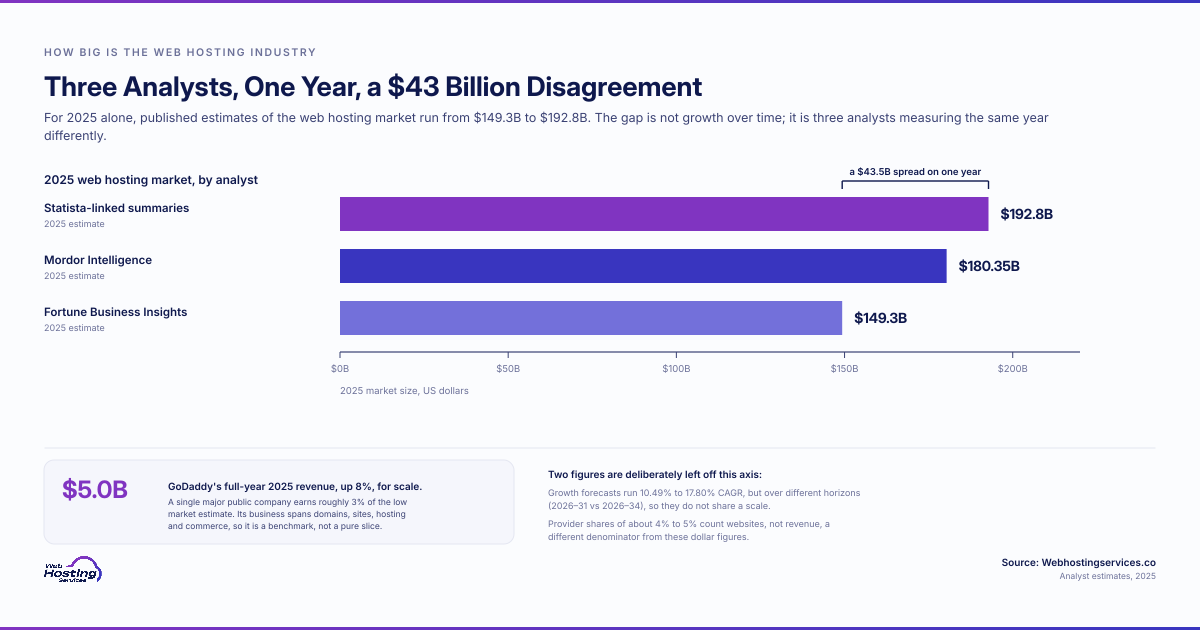
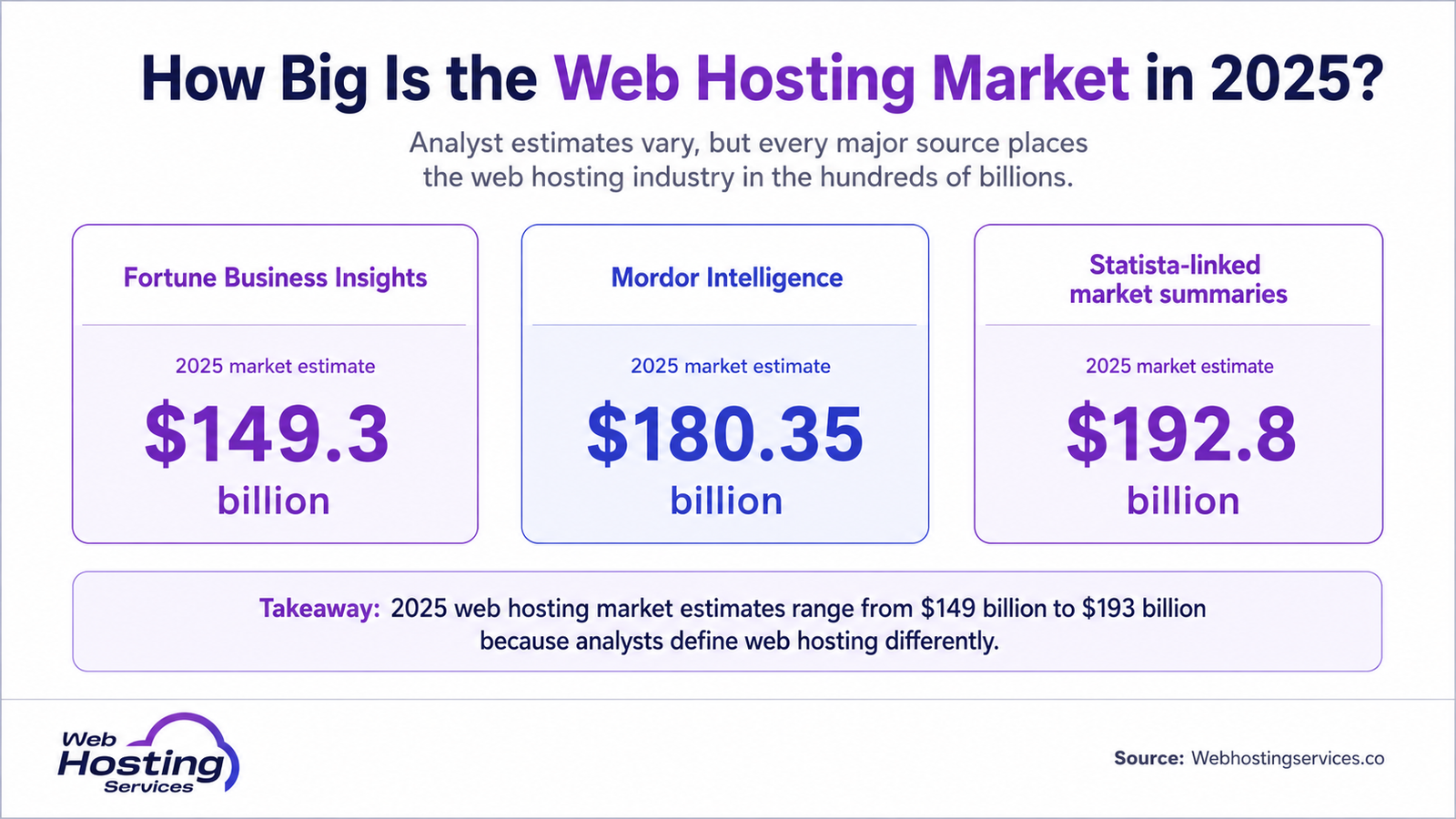
- Estimates for the 2025 web hosting market ranged from about $149 billion to $193 billion.
- Fortune Business Insights valued it at $149.3 billion for 2025.
- Mordor Intelligence placed it higher, at $180.35 billion.
- Statista-linked market summaries put the 2025 figure near $192.8 billion.
- The wide gap reflects how each analyst defines hosting, with some folding in cloud infrastructure.
Analyst | 2025 market estimate |
Fortune Business Insights | $149.3 billion |
Mordor Intelligence | $180.35 billion |
Statista-linked market summaries | $192.8 billion |
The figures disagree, but the direction does not. Every major analyst describes a large, fast-growing market measured in the hundreds of billions, driven by the relentless rise in websites, ecommerce and cloud workloads.
How fast is the web hosting market growing (CAGR)?
Note: growth forecasts vary by analyst and horizon, so these are attributed estimates, not a single agreed figure.
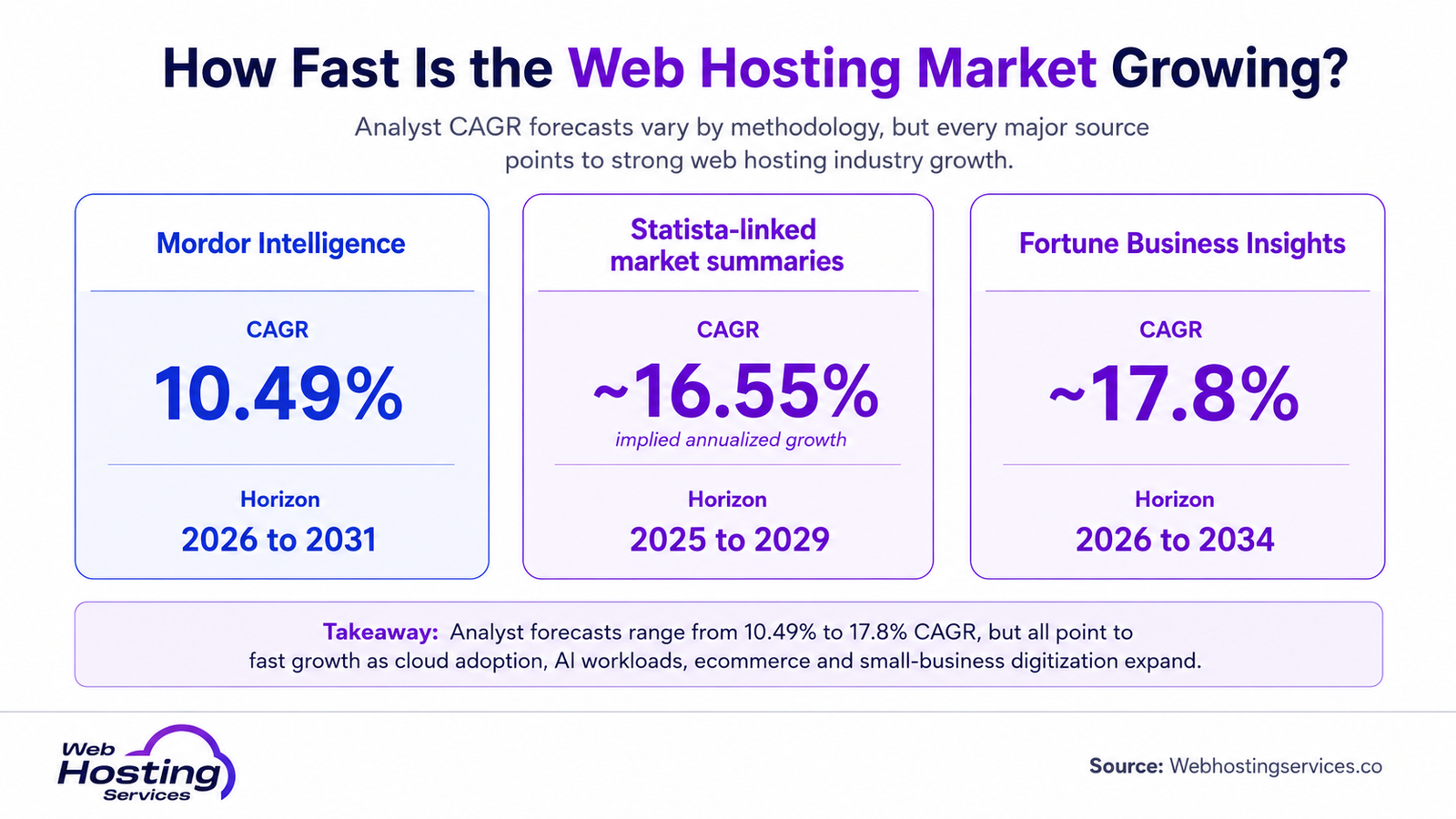
- The listed analyst forecasts range from 10.49% to 17.80% CAGR, depending on methodology and forecast horizon.
- Mordor Intelligence is the most conservative listed source at 10.49% for 2026 to 2031.
- Statista-linked market summaries project a rise from about $192.8 billion in 2025 to $355.8 billion in 2029, which implies about 16.55% annualized growth.
- Fortune Business Insights projects 17.80% for 2026 to 2034.
- Cloud adoption, AI workloads and small-business digital growth are the main drivers.
Analyst | CAGR | Horizon |
Mordor Intelligence | 10.49% | 2026 to 2031 |
Statista-linked market summaries | ~16.55% implied annualized growth | 2025 to 2029 |
Fortune Business Insights | ~17.8% | 2026 to 2034 |
Whichever forecast holds, hosting is one of the faster-growing corners of tech. The spread comes from differing views on how quickly cloud and AI infrastructure spending will accelerate over the coming decade.
Which companies have the largest web hosting market share?
Note: W3Techs measures share of all websites, and these figures shift constantly, so treat them as a snapshot.
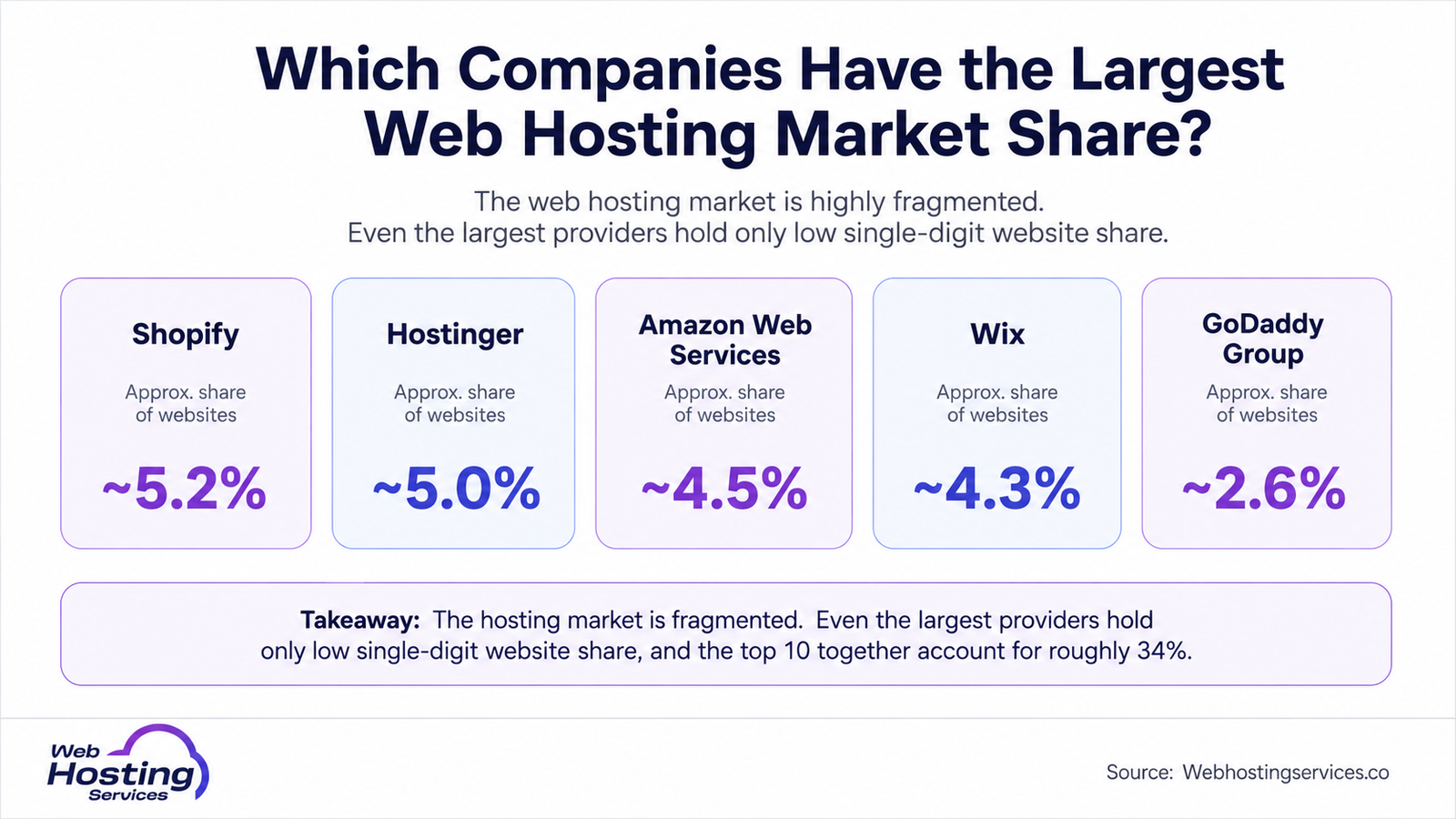
- No provider dominates, with the leaders each holding only about 4% to 5% of all websites.
- According to W3Techs, Shopify leads at about 5.2%, followed by Hostinger at about 5.0%.
- Hostinger has overtaken Amazon Web Services for second place in W3Techs’ web hosting provider ranking.
- Website builders like Shopify and Wix rank high because W3Techs counts websites, not revenue.
- The top 10 providers together account for roughly 34% of tracked websites.
Provider | Approx. share of websites |
Shopify | ~5.2% |
Hostinger | ~5.0% |
Amazon Web Services | ~4.5% |
Wix | ~4.3% |
GoDaddy Group | ~2.6% |
The takeaway is fragmentation at the top. Even the biggest names hold low single-digit shares, which is why the market supports thousands of providers rather than a single dominant host.
How many web hosting companies are there?
Note: this figure is an industry estimate, since no official registry counts every hosting provider.
- There are estimated to be more than 330,000 web hosting companies worldwide.
- They range from global platforms to tiny niche and reseller operations.
- The market is highly fragmented, despite the top 10 holding about a third of share.
- Low barriers to entry, helped by reseller hosting, keep the company count high.
- Most providers are small, serving local markets or specific niches.
Metric | Estimate |
Web hosting companies worldwide | 330,000+ |
Top 10 combined market share | ~34% |
That huge company count alongside a concentrated top tier captures the shape of the industry. A few giants serve the bulk of high-traffic sites, while a long tail of small hosts and resellers serves everyone else.
What share of the web hosting market is in North America?
Note: regional shares are analyst estimates and vary slightly by source.
- North America is the largest region, holding roughly 39% to 41% of the global market in 2025.
- Fortune Business Insights put North America at 41%, or about $61.18 billion.
- Mordor estimated a slightly lower 38.63% share.
- The United States generates the most hosting revenue of any single country.
- Asia-Pacific is the fastest-growing region, driven by ecommerce and digital-payment adoption.
Region | Approx. 2025 share |
North America | ~39% to 41% |
Europe | Second largest |
Asia-Pacific | Fastest-growing |
North America leads on the strength of dense data-center clusters and early cloud adoption. Growth there is moderating toward saturation, while Asia-Pacific is where the fastest expansion is now happening.
How much revenue do the largest hosting providers make?
- GoDaddy, a major publicly traded domains and hosting-focused company, reported $5.0 billion in full-year 2025 revenue, up 8% year over year.
- That was up from $4.573 billion in 2024.
- Its 2025 net income was $875.0 million, with free cash flow of $1.6 billion.
- Quarterly revenue ran between $1.2 billion and $1.3 billion through 2025.
- Cloud giants like AWS earn far more, but hosting is only a slice of their broader cloud revenue.
GoDaddy metric | Figure |
2024 revenue | $4.573 billion |
2025 revenue | $5.0 billion |
2025 net income | $875.0 million |
2025 free cash flow | $1.6 billion |
GoDaddy is a useful revenue benchmark because its numbers are filed publicly and its business is closely tied to domains, websites, hosting and commerce tools. Privately held hosts like Newfold and cloud divisions inside Amazon and Google make direct comparison harder. For the customer side, see our web hosting cost research.
Sources & additional resources
- “Web Hosting Services Market Size and Share.” Fortune Business Insights.
- “Web Hosting Market Size and Growth Analysis.” Mordor Intelligence.
- “Web Hosting Worldwide Market Forecast.” Statista.
- “70 Web Hosting Statistics of 2026.” DemandSage.
- “How Many Web Hosting Companies Are There?.” HostingAdvice.
- “Usage Statistics of Web Hosting Providers.” W3Techs.
- “GoDaddy Investor Relations and Financial Results.” GoDaddy.
Web Hosting Services helps you make sense of this sprawling market, with independent hosting research, current hosting deals from providers across every tier, plus managed WordPress hosting built for performance and value.