









 By: Mendy Perlman
|
Updated: June 21, 2026
|
Fact Checked
|
By: Mendy Perlman
|
Updated: June 21, 2026
|
Fact Checked
|
Cite this Research
Cite this research
Perlman, M. (2026, June 21). Shopify statistics - stores, GMV and market share. Web Hosting Services. https://webhostingservices.co/research/shopify-statistics
Perlman, Mendy. “Shopify Statistics - Stores, GMV and Market Share.” Web Hosting Services, 21 June 2026, https://webhostingservices.co/research/shopify-statistics.
Perlman, Mendy. “Shopify Statistics - Stores, GMV and Market Share.” Web Hosting Services. Last modified June 21, 2026. https://webhostingservices.co/research/shopify-statistics.
How many stores and merchants are on Shopify?
Note: store counts vary by tracker, since website detections, live stores and active merchant counts are measured differently.
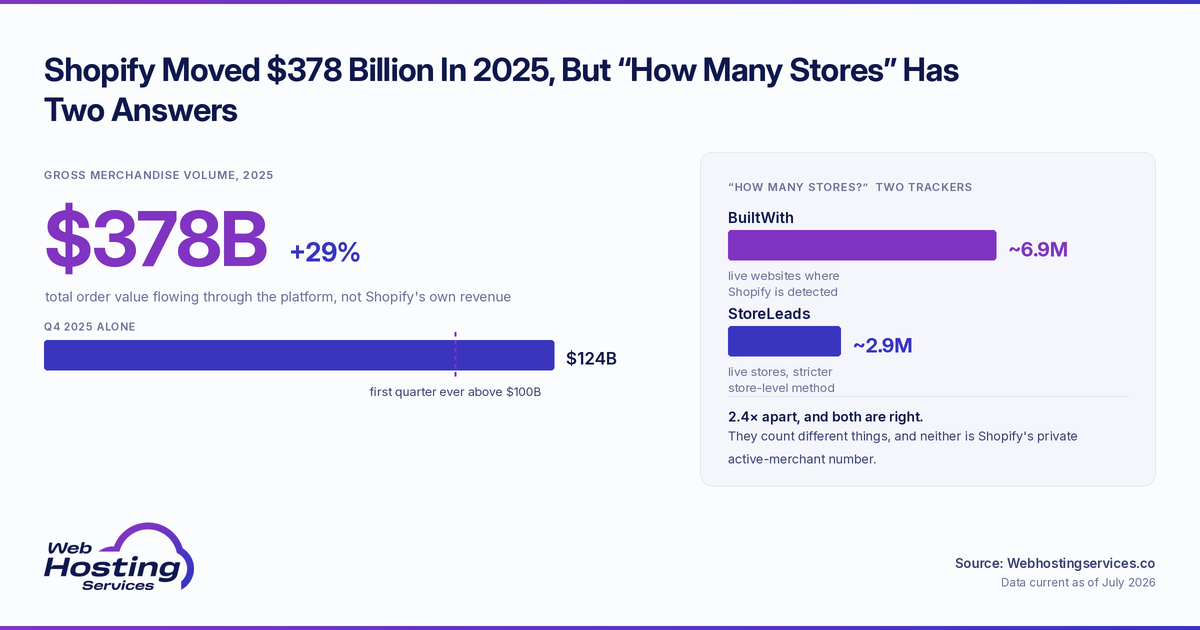
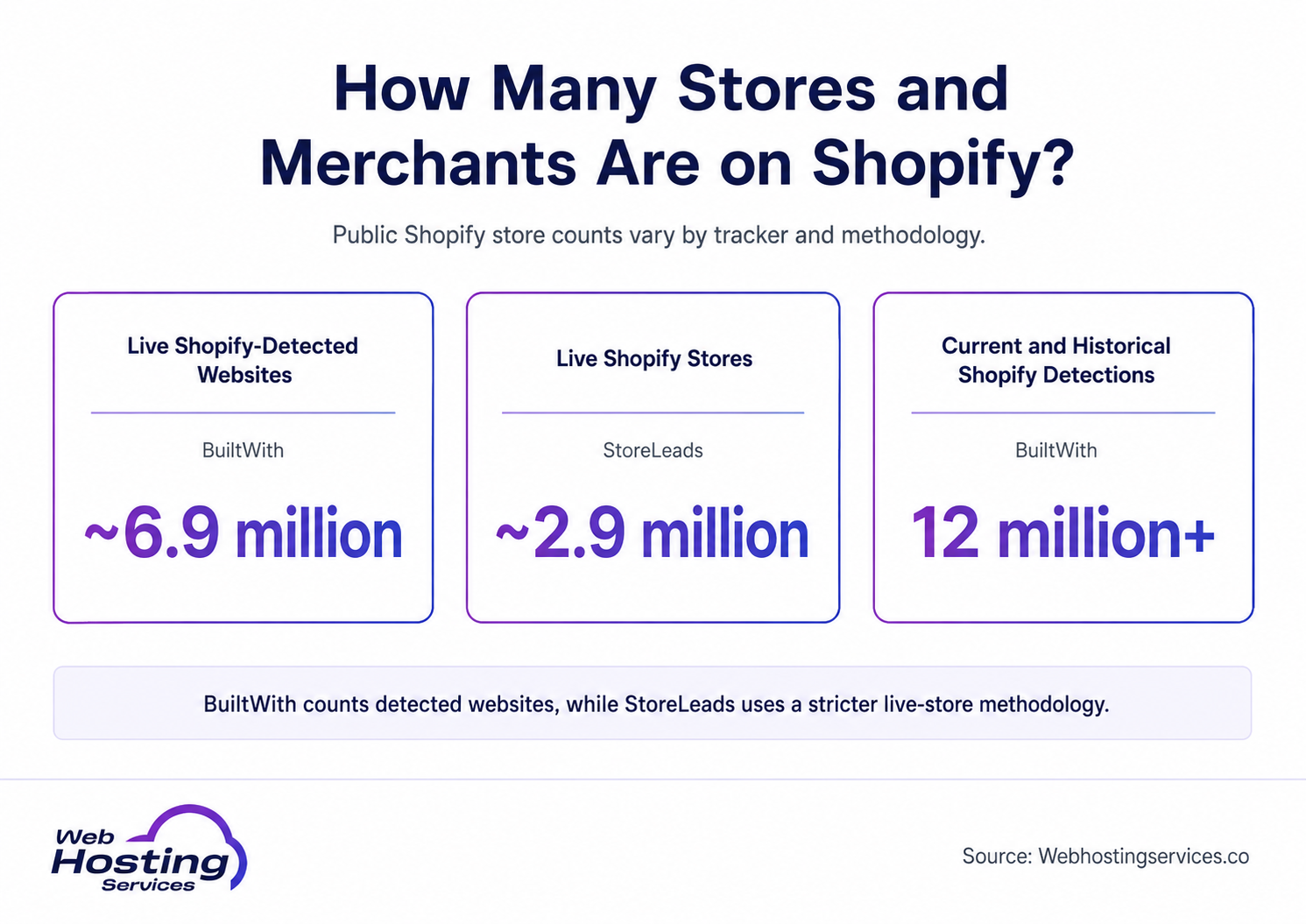
- BuiltWith detects about 6.9 million live websites using Shopify.
- StoreLeads separately counts about 2.9 million live Shopify stores, using a stricter store-level methodology.
- BuiltWith reports more than 12 million current and historical websites with Shopify detections.
- Shopify powers merchants across more than 175 countries.
- An entrepreneur makes a first sale on Shopify roughly every 26 seconds.
Metric | Figure |
Live Shopify-detected websites (BuiltWith) | ~6.9 million |
Live Shopify stores (StoreLeads) | ~2.9 million |
Current and historical Shopify detections (BuiltWith) | 12 million+ |
The gap between trackers matters. BuiltWith counts live websites where Shopify is detected, while StoreLeads counts live Shopify stores using a stricter store-level methodology. Neither public tracker is the same as Shopify’s private active-merchant count.
What is Shopify’s gross merchandise volume (GMV)?
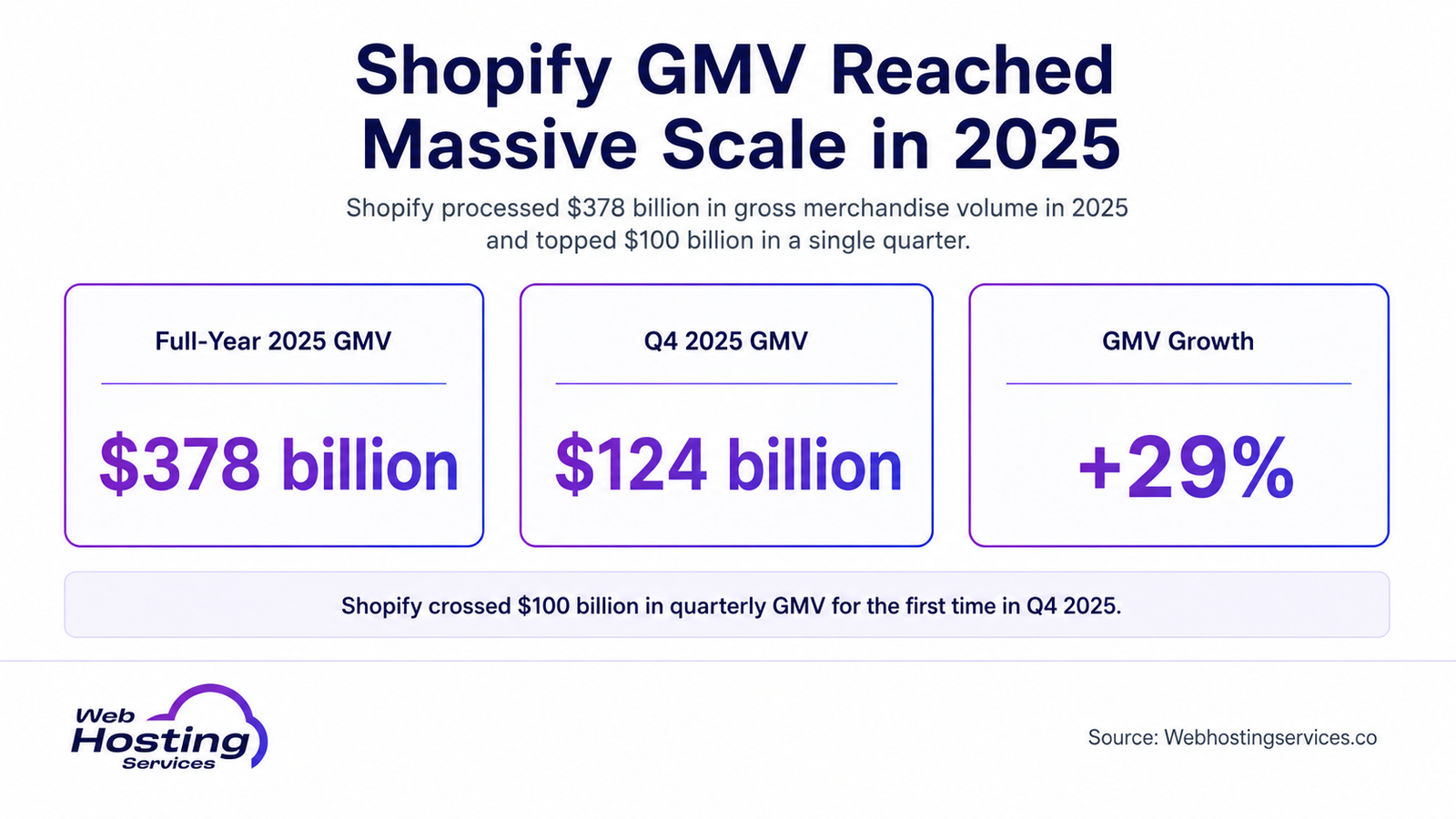
- Shopify merchants processed $378 billion in GMV across all of 2025, up 29% year over year.
- The fourth quarter alone hit $124 billion, the first quarter ever above $100 billion.
- Shopify’s GMV has more than tripled since 2020.
- Shopify Payments processed $84 billion in Q4, about 68% of total GMV.
- B2B GMV nearly doubled in 2025, growing 96% as wholesale adoption surged.
Metric | Figure |
Full-year 2025 GMV | $378 billion |
Q4 2025 GMV | $124 billion |
GMV growth | +29% |
GMV is one of the clearest measures of Shopify’s scale, since it captures the total value of orders facilitated through its platform. Crossing $100 billion in a single quarter shows how large the platform’s commerce engine has become.
How much annual revenue does Shopify make?
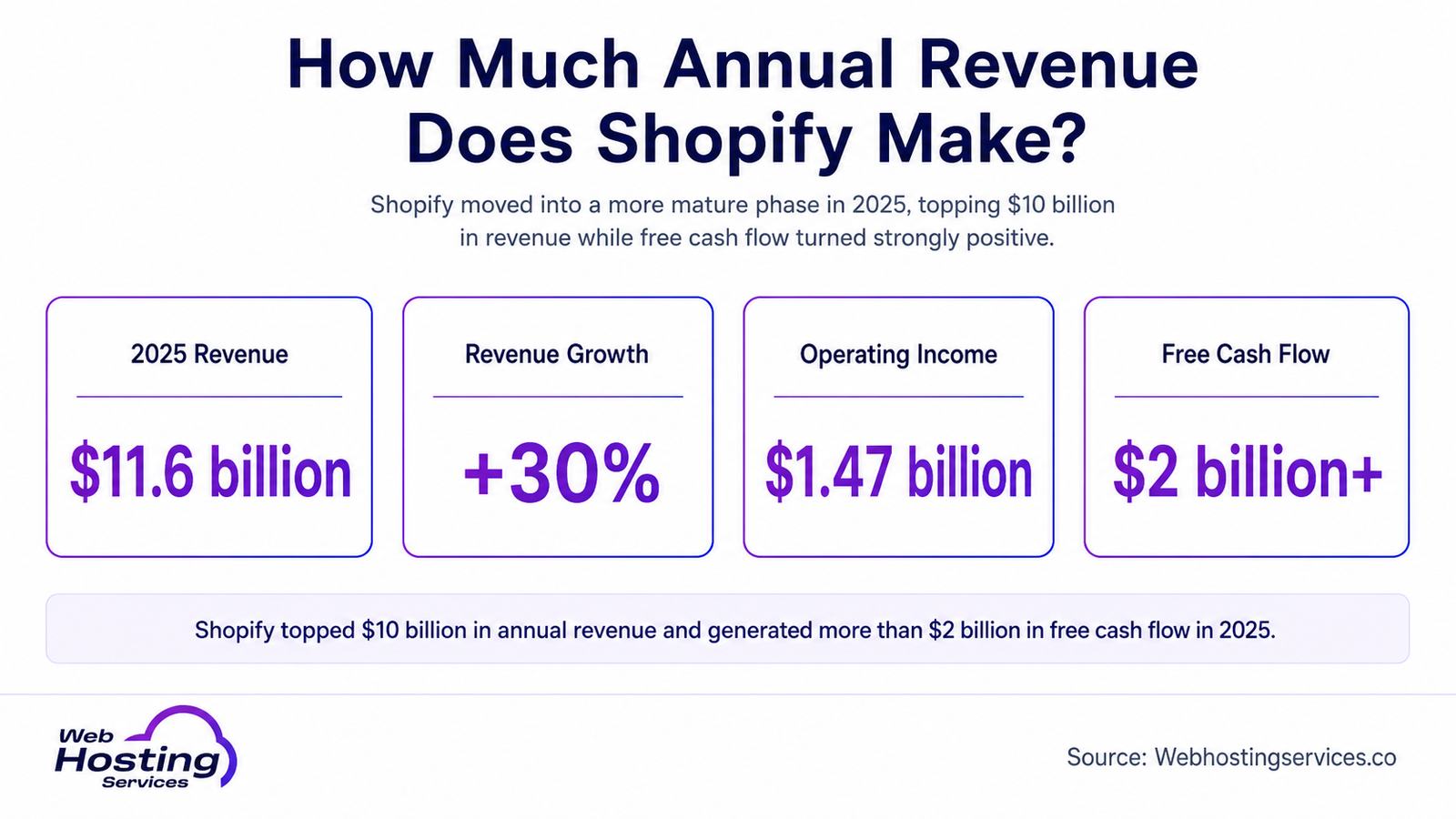
- Shopify generated $11.6 billion in revenue in 2025, up 30% year over year.
- It was the first year Shopify revenue topped $10 billion.
- The fourth quarter was the first to exceed $3 billion in quarterly revenue.
- Operating income reached $1.47 billion, up about 37%.
- Free cash flow exceeded $2 billion, a 17% margin.
Metric | Figure |
2025 revenue | $11.6 billion |
Revenue growth | +30% |
Operating income | $1.47 billion |
Free cash flow | $2 billion+ |
Shopify has shifted from growth-at-all-costs to profitable growth. Revenue nearly quadrupled since 2020 while free cash flow turned strongly positive, a combination that reset how investors value the business.
What is Shopify’s ecommerce platform market share?
Note: market share varies enormously by methodology, so the measure matters as much as the number.
- Among top-traffic ecommerce sites, third-party estimates commonly put Shopify near 29%, with exact share depending on whether Shopify Plus is counted separately.
- Across all ecommerce sites, estimates range from about 10% on platform-market measures to over 20% by broad website-detection methods.
- WooCommerce can lead raw live-store counts in some trackers, while Shopify’s $378 billion in 2025 GMV shows its scale among larger merchants.
- Shopify is especially strong among high-traffic ecommerce sites, but the exact ranking depends on the tracker and denominator.
- Shopify lists major brands such as Mattel, Gymshark, Netflix, SKIMS and Supreme among businesses using the platform.
Measure | Shopify share |
Top 1 million ecommerce sites | ~27% to 29% |
All ecommerce sites | ~10% to 25%, varies by tracker |
The methodology gap explains conflicting headlines. WooCommerce can look larger by raw live-store count, while Shopify looks stronger in GMV, hosted-commerce scale and high-traffic ecommerce datasets. The safest reading is source-specific: store count, website detections, GMV and top-site share measure different things.
How many Shopify merchants are there by country?
Note: country-level store counts come from third-party trackers and are approximate.
- The United States is Shopify’s largest market by both BuiltWith website detections and StoreLeads live-store counts.
- BuiltWith detects about 3.8 million Shopify websites in the US, while StoreLeads counts about 1.1 million live Shopify stores there.
- Third-party market-share estimates put Shopify near 29% to 30% of the US ecommerce software market, depending on methodology.
- The next-largest markets commonly include the UK, Australia, Canada and Germany.
- International revenue grew 36% in 2025, outpacing overall revenue growth.
Country | Position |
United States | Largest market; ~3.8M detected websites (BuiltWith) and ~1.1M live stores (StoreLeads) |
United Kingdom | Second-largest |
Australia, Canada, Germany | Major markets |
Shopify began as a North American platform but its growth story is now global. With nearly half of merchants abroad and international revenue rising fastest, the platform’s future expansion is increasingly outside the US.
How much is Shopify worth (market cap)?
Note: market cap moves daily with the share price, so this is a recent approximate figure.
- Shopify’s market cap sat around $140 billion in mid-2026.
- It trades on both the NASDAQ and TSX under the ticker SHOP.
- It is one of the most valuable companies in Canada.
- The valuation rests on revenue that nearly quadrupled since 2020.
- Shopify expanded its share buyback authorization to $5 billion in 2026, up from the $2 billion launched with its 2025 results.
Metric | Figure |
Market cap (mid-2026) | ~$140 billion |
Listings | NASDAQ and TSX (SHOP) |
Share buyback | $5 billion authorization |
The market cap reflects Shopify’s rare combination of scale and growth. Few companies its size still grow revenue at 30%, which is what keeps its valuation among the highest in ecommerce. For the cost side, see our Shopify cost research.
Sources & additional resources
- “Shopify Investor Relations and Financial Results.” Shopify.
- “Shopify Q4 2025 Financial Results.” Shopify.
- “Shopify Usage Statistics and Trends.” BuiltWith.
- “Shopify Revenue and GMV, Q4 2025.” Digital Commerce 360.
- “Shopify Statistics.” DemandSage.
- “The State of Shopify in 2026.” StoreLeads.
- “Shopify Stores in the United States.” StoreLeads.
- “Shopify Market Share Stats 2026.” Red Stag Fulfillment.
- “Shopify Q4 2025 Slides: Revenue Hits $3.7B.” Investing.com.
- “Shopify Market Cap.” StockAnalysis.
- “Shopify Announces $3 Billion Increase to Share Repurchase Program.” Shopify.
Web Hosting Services helps you sell online for less, with independent ecommerce and hosting research, current hosting and platform deals, plus managed WordPress hosting for store owners who prefer to own their stack.