










 By: Mendy Perlman
|
Updated: June 21, 2026
|
Fact Checked
|
By: Mendy Perlman
|
Updated: June 21, 2026
|
Fact Checked
|
Cite this Research
Cite this research
Perlman, M. (2026, June 21). Ecommerce platform market share statistics. Web Hosting Services. https://webhostingservices.co/research/ecommerce-platform-market-share
Perlman, Mendy. “Ecommerce Platform Market Share Statistics.” Web Hosting Services, 21 June 2026, https://webhostingservices.co/research/ecommerce-platform-market-share.
Perlman, Mendy. “Ecommerce Platform Market Share Statistics.” Web Hosting Services. Last modified June 21, 2026. https://webhostingservices.co/research/ecommerce-platform-market-share.
Which ecommerce platforms have the largest market share?
Note: platform share varies enormously by methodology, so the measure matters as much as the number.
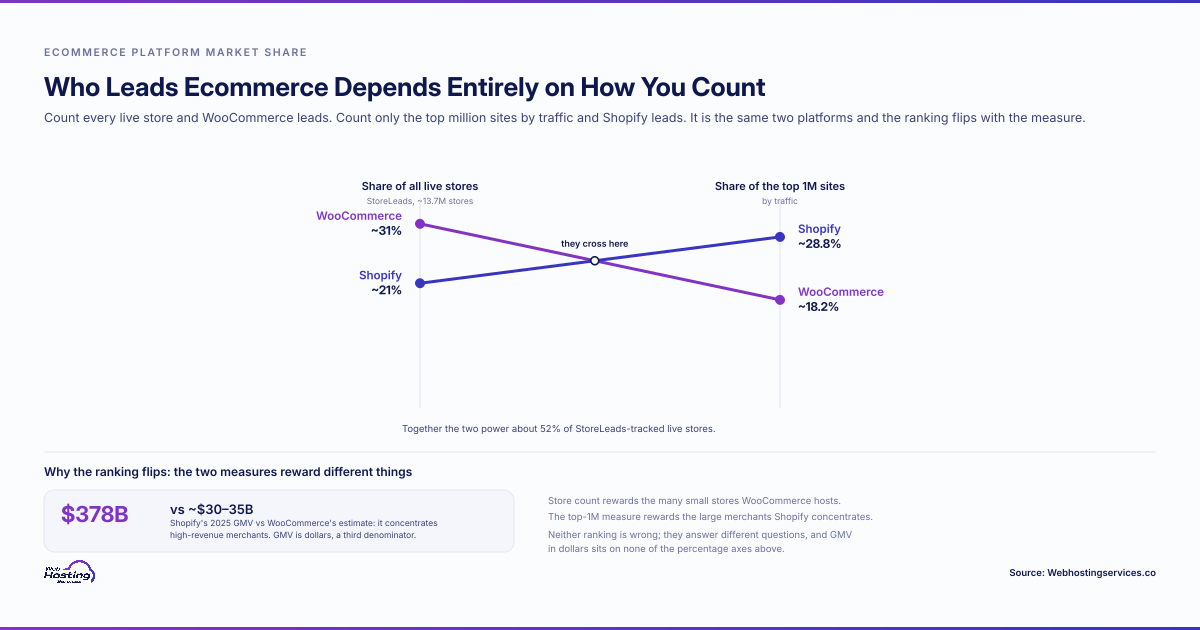
- By StoreLeads live-store count, WooCommerce leads at about 31%.
- Shopify ranks second by count at about 21%, followed by custom carts near 12%.
- Among the top 1 million ecommerce sites, the order flips, with Shopify at 28.8% and WooCommerce at 18.2%.
- Wix holds around 7% by store count, with Squarespace and Magento behind.
- WooCommerce leads by StoreLeads live-store count, while Shopify leads on reported GMV and high-traffic ecommerce share.
Platform | Share by store count | Position |
WooCommerce | ~31% | Count leader |
Shopify | ~21% | GMV and top-site leader |
Custom carts | ~12% | Custom and enterprise builds |
Wix | ~7% | Small business |
There is no single correct answer to which platform leads, only the right measure for your question. StoreLeads live-store count favors WooCommerce, while reported GMV and high-traffic ecommerce datasets favor Shopify.
What is the Shopify versus WooCommerce market share?
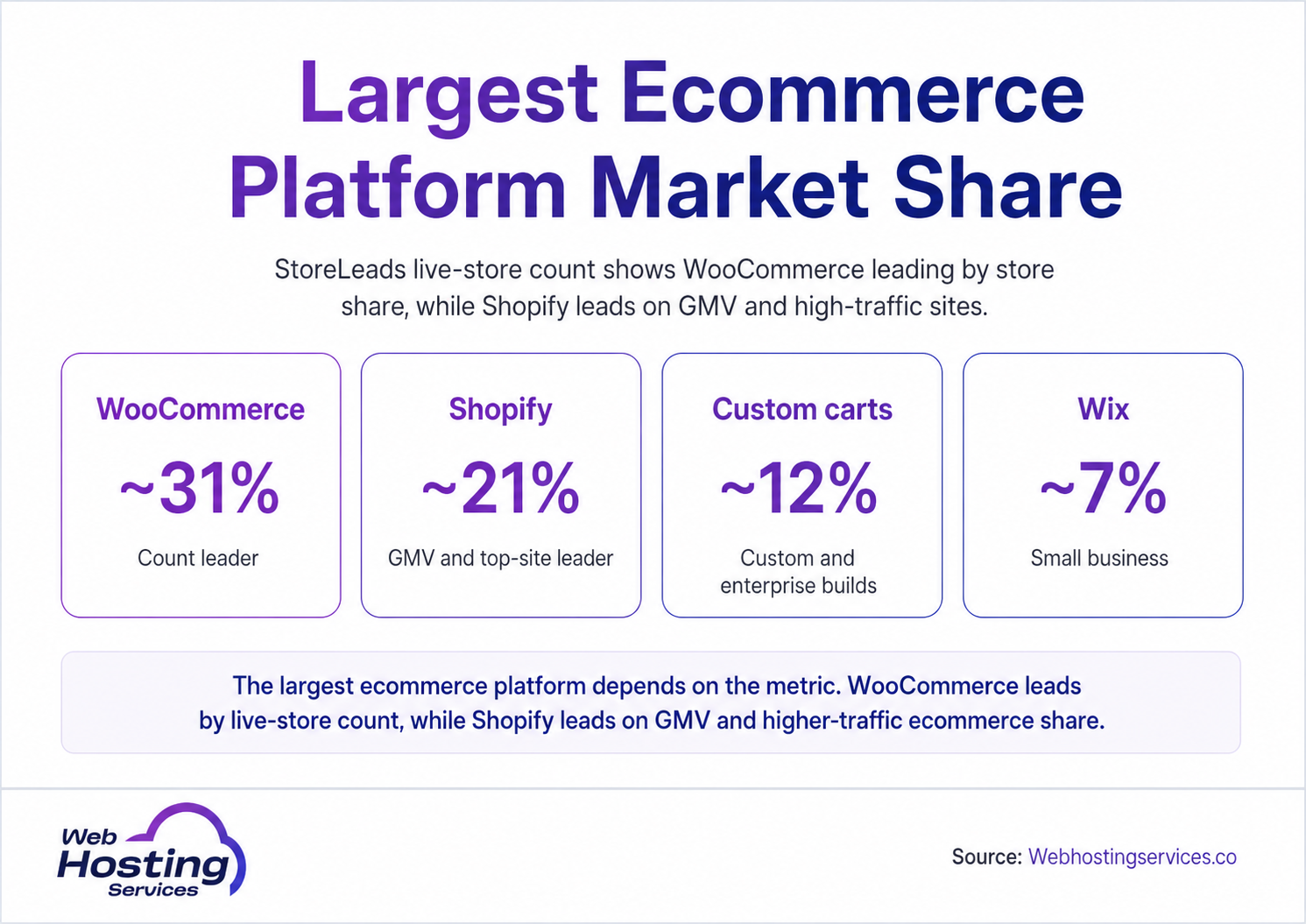
- By StoreLeads live-store count, WooCommerce leads with about 4.2 million stores to Shopify’s 2.9 million.
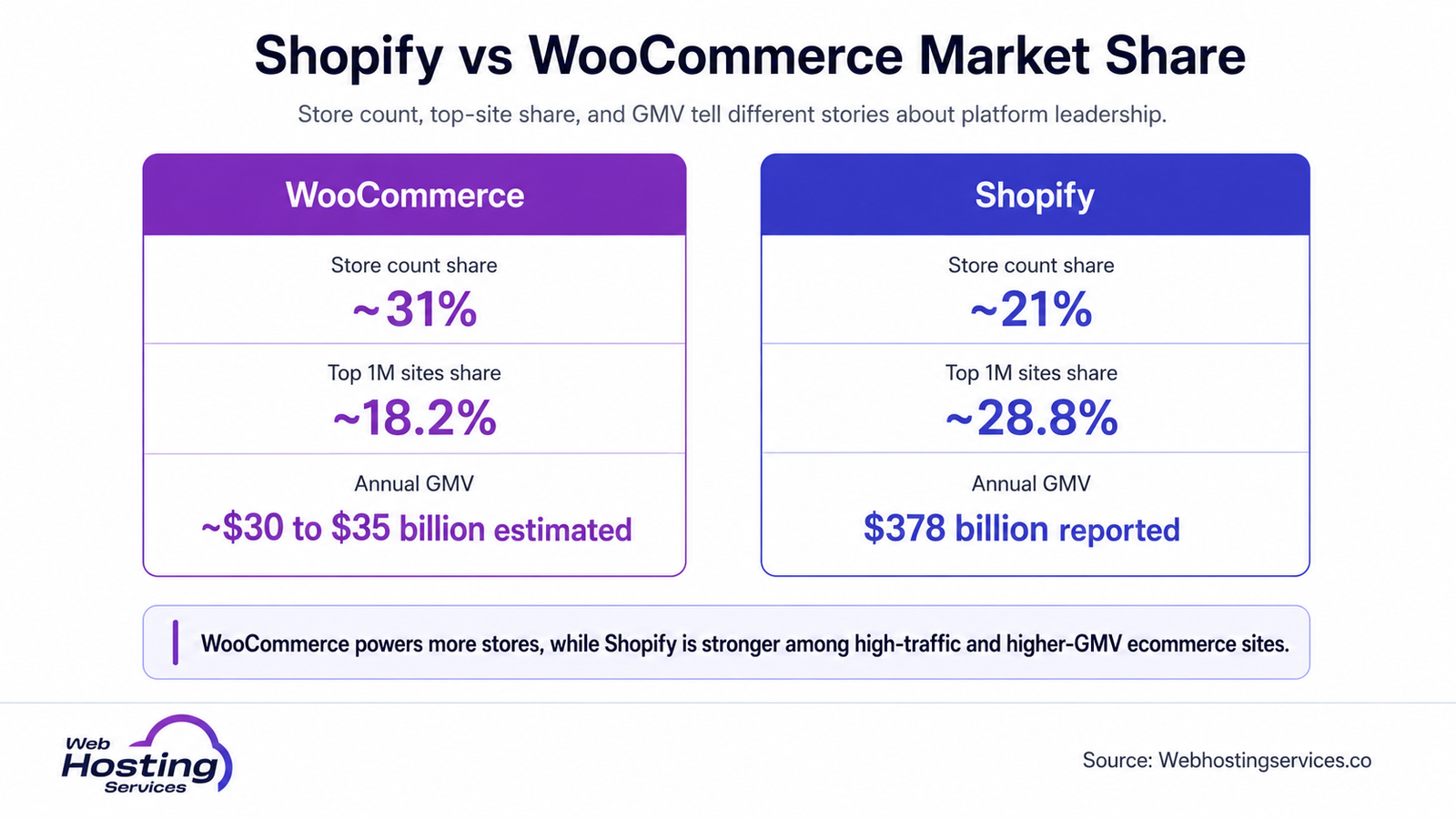
- Among the top 1 million ecommerce sites, Shopify leads at 28.8% versus 18.2%.
- Shopify’s GMV reached $378 billion in 2025, far above WooCommerce’s estimated $30 to $35 billion.
- WooCommerce wins on flexibility and its free, open-source model on WordPress.
- Together, the two platforms power more than half of StoreLeads-tracked live ecommerce stores.
Metric | WooCommerce | Shopify |
Store count share | ~31% | ~21% |
Top 1M sites share | ~18.2% | ~28.8% |
Annual GMV | ~$30 to $35 billion estimated | $378 billion reported |
The rivalry captures a real divide in ecommerce. WooCommerce powers more stores, especially smaller ones, while Shopify concentrates the large, high-revenue merchants, which is why it leads so decisively on total sales volume. See our Shopify statistics for the full revenue picture.
How many online stores are there?
Note: total store counts depend heavily on whether you count active stores or all detected sites.
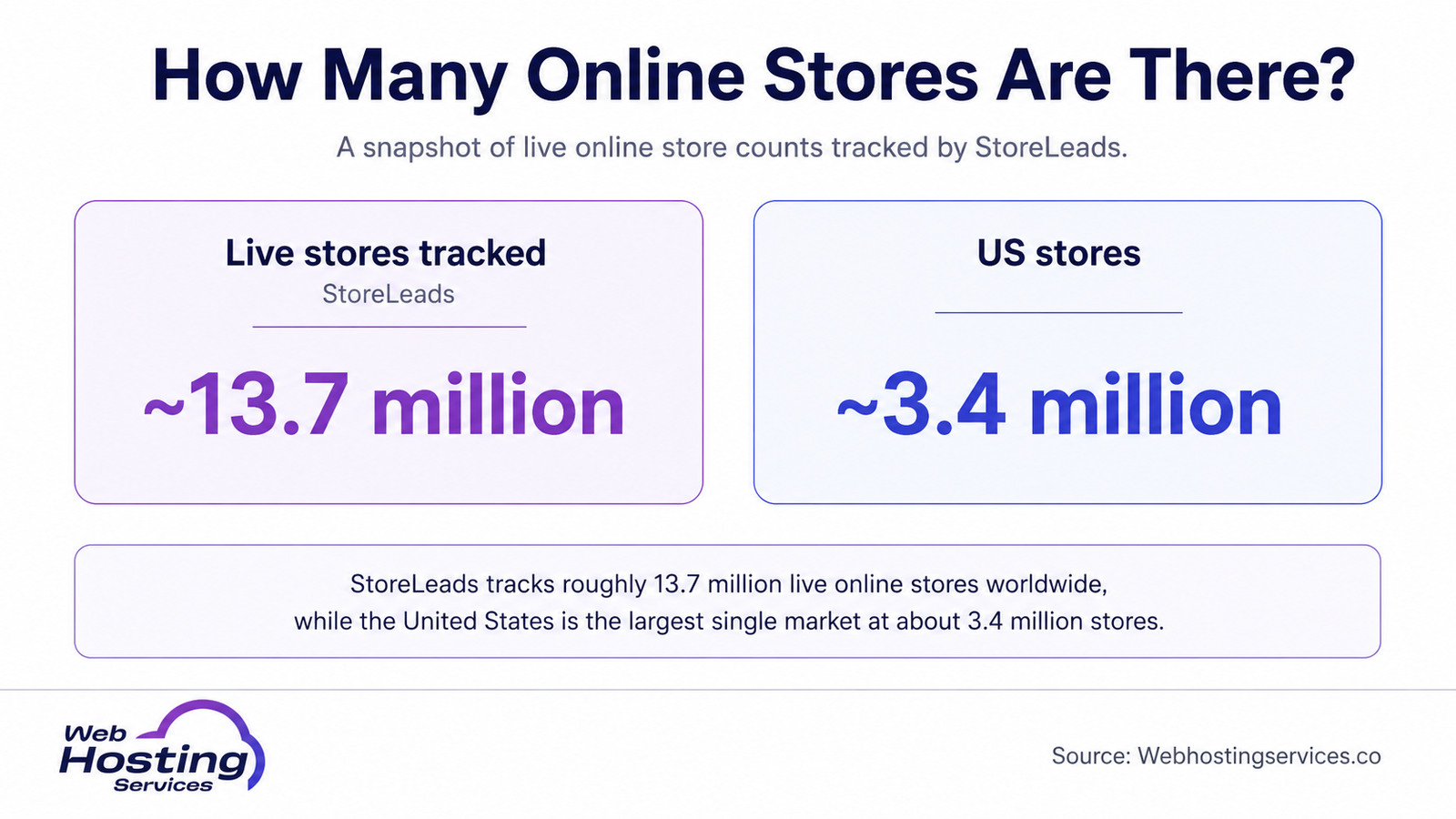
- StoreLeads tracks roughly 13.7 million live online stores worldwide across all platforms.
- Broader detection methods that include inactive and partial sites run higher.
- The United States is the largest single market in StoreLeads’ tracker, with about 3.4 million stores.
- The total grows constantly as new merchants launch on hosted and open-source platforms.
- The count varies by source because “online store” has no single agreed definition.
Metric | Figure |
Live stores tracked (StoreLeads) | ~13.7 million |
US stores | ~3.4 million |
The honest answer is a range, not a single figure. Counting live stores gives about 13.7 million in StoreLeads, while counting every detectable storefront or historical technology detection pushes the number higher.
How many websites use WooCommerce?
- StoreLeads reports about 4.2 million live WooCommerce stores, down from its 2024 peak.
- BuiltWith detects roughly 6.2 million websites using WooCommerce technology.
- W3Techs reports WooCommerce runs on about 8% of all websites.
- WordPress.org shows more than 7 million active plugin installations.
- The plugin has been downloaded more than 344 million times since 2011.
Source | WooCommerce figure |
Live stores (StoreLeads) | ~4.2 million |
Detected sites (BuiltWith) | ~6.2 million |
Share of all websites (W3Techs) | ~8% |
The numbers differ because they measure different things. StoreLeads counts about 4.2 million live WooCommerce stores, while BuiltWith technology detections capture a broader set of sites where WooCommerce is detected.
How does ecommerce platform share vary by region?
Note: regional figures come from third-party trackers and vary by methodology.
- Across StoreLeads’ tracked ecommerce platforms, the United States is the largest single country market.
- WooCommerce’s largest StoreLeads markets are the US (about 12% of its stores), UK, India and Germany, followed by several European markets and Brazil.
- WooCommerce is especially strong across Europe and in India, where WordPress adoption and cost sensitivity run high.
- Shopify concentrates in the US, UK, Australia and Canada.
- Wix and Squarespace skew heavily toward US small businesses.
Country | Position among WooCommerce markets |
United States | Largest, about 12% of WooCommerce stores |
United Kingdom | Second-largest, about 4% |
India and Germany | Major markets after the US and UK |
Italy, Netherlands, Spain, France and Brazil | Other sizable StoreLeads markets |
Platform choice follows local habits. Open-source WooCommerce thrives where developers and cost-conscious merchants dominate, while hosted Shopify leads in markets that favor speed and simplicity over control. For the cost comparison, see our Shopify cost research.
Sources & additional resources
- “The State of Ecommerce in 2026.” StoreLeads.
- “The State of WooCommerce in 2026.” StoreLeads.
- “Shopify Q4 and Full-Year 2025 Financial Results.” Shopify.
- “WooCommerce Usage Statistics.” BuiltWith.
- “Usage Statistics and Market Share of WooCommerce.” W3Techs.
- “WooCommerce.” WordPress.org.
- “Shopify Market Share Stats 2026.” Red Stag Fulfillment.
- “What Is WooCommerce’s Gross Merchandise Volume?.” Red Stag Fulfillment.
- “WooCommerce Statistics.” Colorlib.
Web Hosting Services helps you pick the right platform, with independent ecommerce and hosting research, current hosting and platform deals, plus managed WordPress hosting tuned for fast, secure WooCommerce stores.