









 By: Mendy Perlman
|
Updated: June 21, 2026
|
Fact Checked
|
By: Mendy Perlman
|
Updated: June 21, 2026
|
Fact Checked
|
Cite this Research
Cite this research
Perlman, M. (2026, June 21). How many domain names are there? Web Hosting Services. https://webhostingservices.co/research/how-many-domain-names-registered
Perlman, Mendy. “How Many Domain Names Are There?” Web Hosting Services, 21 June 2026, https://webhostingservices.co/research/how-many-domain-names-registered.
Perlman, Mendy. “How Many Domain Names Are There?” Web Hosting Services. Last modified June 21, 2026. https://webhostingservices.co/research/how-many-domain-names-registered.
How many domain names are registered worldwide?
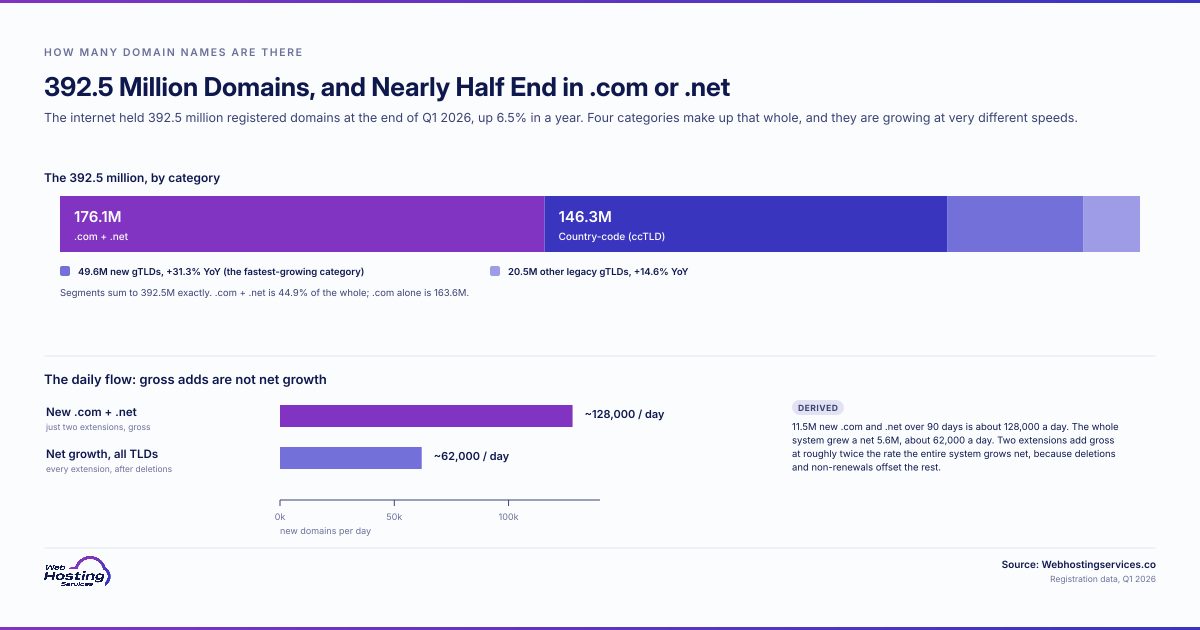
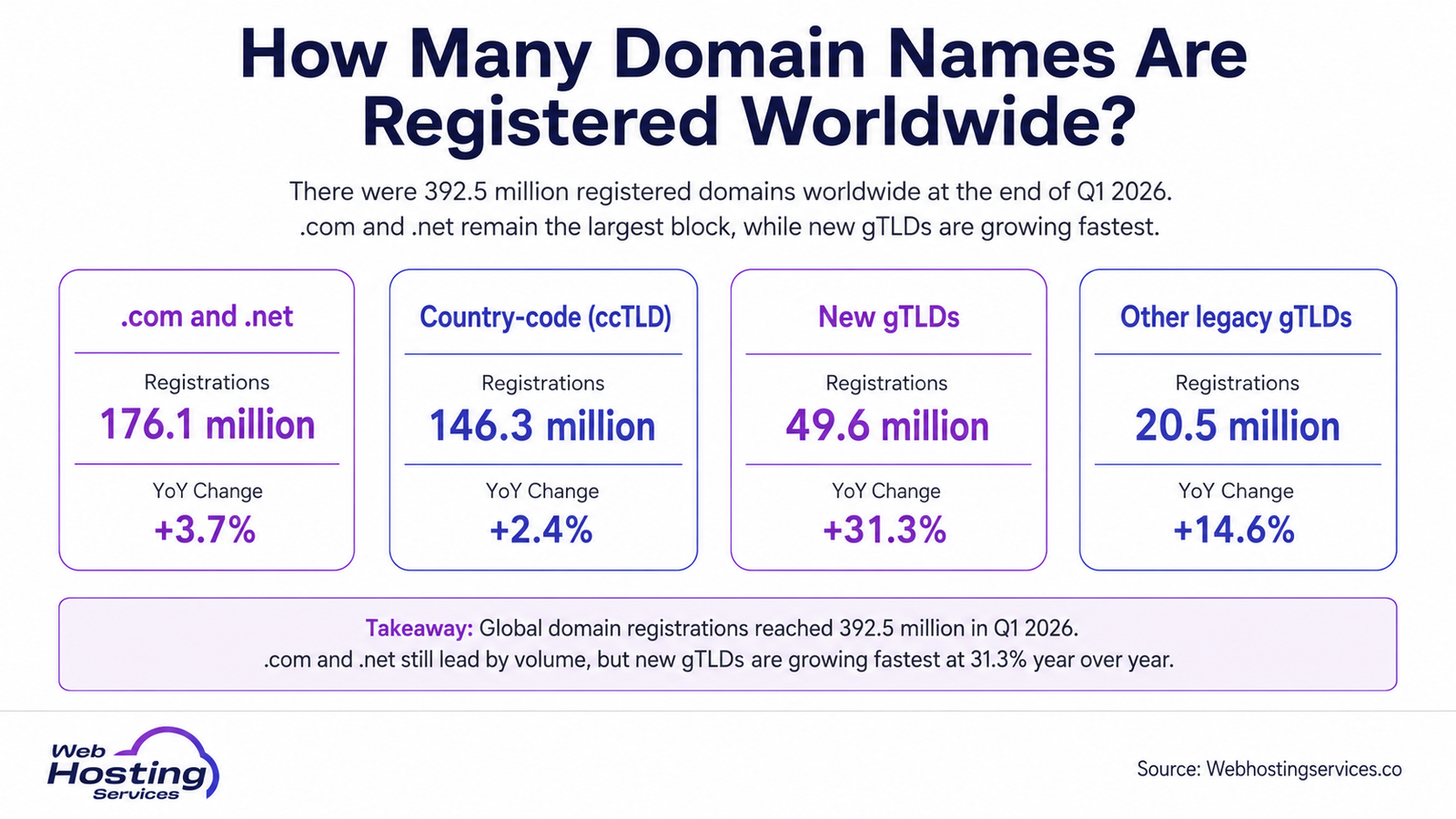
- There were 392.5 million registered domain names across all TLDs at the end of Q1 2026.
- The total grew by 5.6 million, or 1.4%, compared with the previous quarter.
- Year over year, registrations rose by 24.1 million, an increase of 6.5%.
- Country-code domains made up 146.3 million of the total, while .com and .net together accounted for 176.1 million.
- New generic TLDs grew fastest, up 31.3% year over year to 49.6 million.
Category | Registrations | YoY change |
.com and .net | 176.1 million | +3.7% |
Country-code (ccTLD) | 146.3 million | +2.4% |
New gTLDs | 49.6 million | +31.3% |
Other legacy gTLDs | 20.5 million | +14.6% |
The domain market keeps setting records, but growth is uneven. Legacy extensions like .com grow slowly and steadily, while newer generic TLDs are expanding far faster from a smaller base, reshaping where new registrations actually land.
How many .com domain names are there?
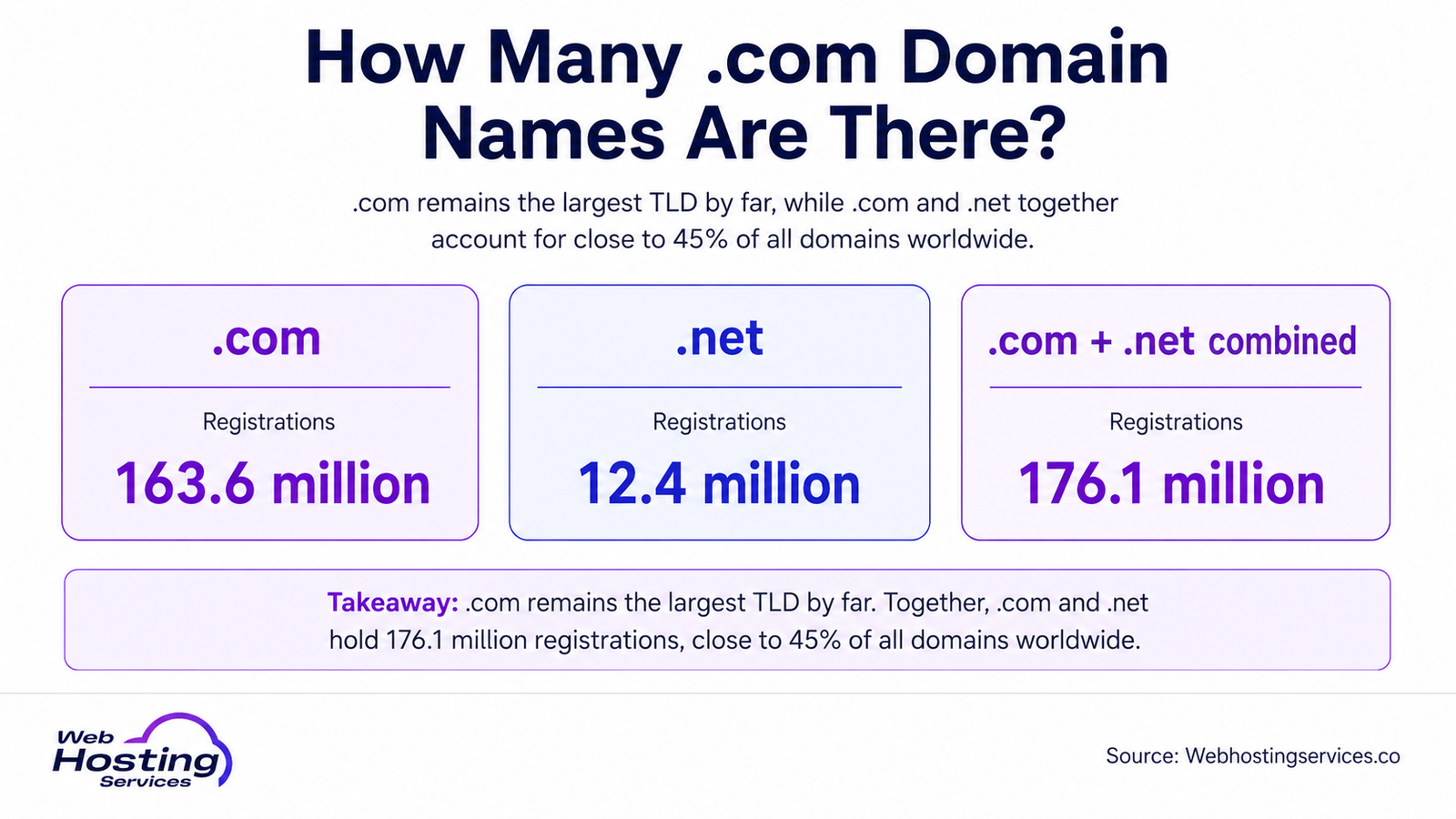
- The .com domain base totaled 163.6 million registrations at the end of Q1 2026.
- The .net extension added another 12.4 million domains.
- Together, .com and .net held 176.1 million, close to 45% of all domains worldwide.
- New .com and .net registrations totaled 11.5 million in the first quarter of 2026.
- The preliminary combined .com and .net renewal rate was 76.3% for Q1 2026.
TLD | Registrations |
.com | 163.6 million |
.net | 12.4 million |
.com + .net combined | 176.1 million |
No other extension comes close to .com by registration volume. It remains the largest TLD in the domain system, with a much larger base than any other single extension.
How many TLDs (domain extensions) exist?
- DNIB counted 1,265 delegated gTLD extensions in the root zone as of March 31, 2026.
- DNIB also counted 316 delegated global country-code extensions, including internationalized domain names.
- Together, that makes 1,581 delegated gTLD and ccTLD extensions in the DNIB Q1 2026 framing.
- Most gTLD extensions are newer additions created after ICANN’s expansion program, while early generic TLDs included .com, .edu, .gov, .int, .mil, .net and .org.
- The IANA Root Zone Database remains the authoritative public record for TLD delegation details.
TLD type | Count in DNIB Q1 2026 |
Delegated gTLD extensions | 1,265 |
Delegated country-code TLDs (ccTLD) | 316 |
Delegated gTLD + ccTLD total in DNIB framing | 1,581 |
The number of extensions exploded after ICANN opened new gTLD applications, jumping from a handful to well over a thousand. Yet despite all that choice, registrations stay concentrated in a small number of established extensions.
How many country-code TLDs (ccTLDs) are there?
- There were 316 global country-code TLD extensions delegated in the root zone, including internationalized names, as of March 31, 2026.
- Together they held 146.3 million registrations at the end of Q1 2026.
- The top 10 ccTLDs alone accounted for 57.6% of all country-code domains.
- China’s .cn led, followed by Germany’s .de and the United Kingdom’s .uk.
- Renewal-rate estimates among the leaders ranged from 72.0% for .ru to 82.1% for .fr.
Rank | ccTLD | Country / region |
1 | .cn | China |
2 | .de | Germany |
3 | .uk | United Kingdom |
4 | .ru | Russia |
5 | .nl | Netherlands |
Country-code domains anchor local identity online, which is why a handful of large national extensions dominate the category. The concentration mirrors the wider market, where a few popular endings carry the bulk of registrations.
How many new domains are registered each day?
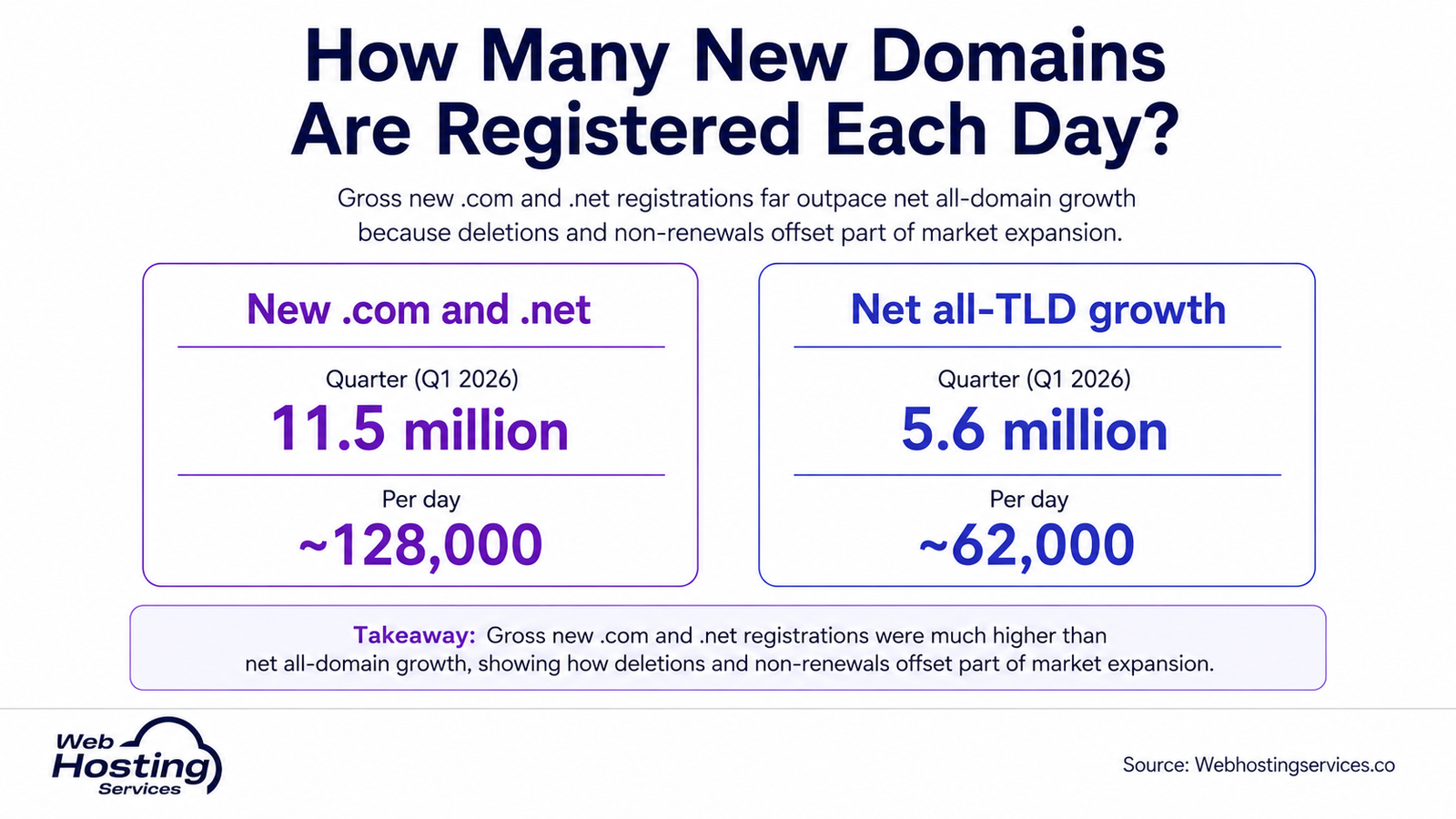
- New .com and .net registrations reached 11.5 million in the first quarter of 2026.
- That works out to roughly 128,000 new .com and .net domains every day across the 90-day quarter.
- Across all TLDs, the total base grew by a net 5.6 million in the quarter.
- That net growth is about 62,000 additional domains per day worldwide.
- The new .com and .net figure rose from 10.1 million in the same quarter a year earlier.
Metric | Quarter (Q1 2026) | Per day |
New .com and .net | 11.5 million | ~128,000 |
Net all-TLD growth | 5.6 million | ~62,000 |
The daily flow is enormous, even though deletions and non-renewals offset some of it. The gap between gross .com and .net adds and net all-TLD growth is a reminder that gross registrations and net market expansion are different measurements.
Which registrars have the largest domain market share?
Note: registrar totals come from third-party trackers and shift constantly, so treat these as approximate.
- GoDaddy is the largest domain registrar by a wide margin worldwide.
- It manages over 61 million .com domains and more than 3.9 million .net domains.
- GoDaddy has historically held a portfolio several times larger than its closest rival.
- Namecheap and Tucows rank among the next largest registrars by volume.
- Squarespace, which absorbed Google Domains, is now a major registrar as well.
Registrar | Position |
GoDaddy | Clear market leader |
Namecheap | Major budget-focused registrar |
Tucows | Large reseller-driven portfolio |
Squarespace | Absorbed Google Domains |
The registrar market is consolidated at the top, with GoDaddy far ahead and a cluster of large players behind it. For the pricing side of choosing a registrar, see our domain name cost research.
How many DNS root servers are there?
- There are 13 root server identities, named A through M, at the top of the DNS.
- They are operated by 12 independent organizations worldwide.
- Verisign operates two of the 13, the A and J root servers.
- Those 13 addresses are backed by more than 2,000 operational instances using anycast.
- The root server system serves the root zone data that points resolvers toward the authoritative servers for TLDs.
Fact | Figure |
Root server identities | 13 (A to M) |
Operating organizations | 12 |
Operational instances worldwide | 2,000+ |
The 13-server figure is a common point of confusion. It refers to addresses, not machines, since anycast lets each address resolve to hundreds of real servers, giving the DNS its resilience with no single point of failure. For how addresses become websites, see our web protocol adoption research.
Sources & additional resources
- “The Domain Name Industry Brief, Q1 2026.” DNIB.com.
- “Root Zone Database.” Internet Assigned Numbers Authority.
- “Root Server Technical Operations.” Root-Servers.org.
- “History of the New gTLD Program.” ICANN.
- “Domain Name Registrars List.” DomainNameStat.
- “Largest Domain Registrars in 2026.” Cybernews.
Web Hosting Services helps you claim your corner of those 392.5 million domains, with independent domain and hosting research, current domain and hosting deals, plus managed WordPress hosting that pairs your new domain with fast, secure hosting.